
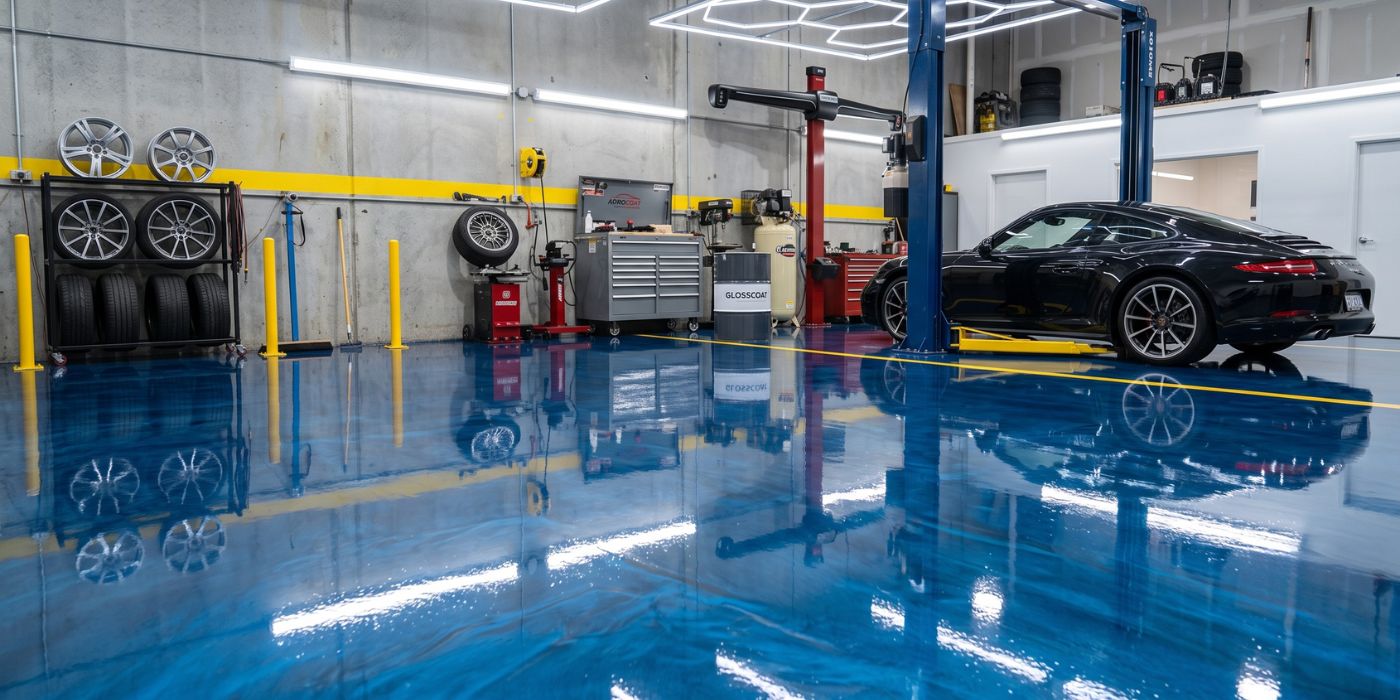
An automotive floor takes a beating that few surfaces have to endure. Motor oil, brake fluid, hot tires, rolling jacks, dropped tools, and lifts loaded with a full vehicle, all working on the same slab every day. Bare or painted concrete gives out fast under that kind of use, and once it starts staining, pitting, and dusting, the floor starts to look neglected in front of the customers you are trying to win.
We are Allied Coatings, and we have been coating industrial and commercial floors across Southern California for more than 25 years. Our commercial epoxy flooring systems are engineered for exactly these environments: service bays, dealership showrooms, detailing areas, and repair shops that need a floor built to work as hard as the operation on top of it. If your floor is already failing, we can assess whether it needs a full coating system or a targeted repair before you spend anything.
Why Auto Shop Floors Fail Faster Than Standard Concrete
Concrete looks tough, but its surface is porous, and that porosity is the whole problem in an auto facility. Here is how a standard slab breaks down under shop use:
- Fluids soak in and stain permanently. Motor oil, brake fluid, and solvents penetrate the open pores of bare concrete, leaving stains that will not clean out and slowly breaking down the surface from within.
- Point loads and hot tires damage the surface. Pressure from lifts, jacks, and rolling equipment causes the top layer to spall, while hot tire pickup can lift material off an unprotected floor.
- Damage spreads once the surface breaks. With the surface compromised, contaminants reach deeper into the slab, dusting increases, and cleanup turns into a daily fight.
- Dust grinds into equipment. The same concrete dust wears on tools and equipment and makes the whole space look worn down in front of customers.
The reason this matters is that a working bay faces stressors most coatings were never built for. Tires arriving at highway temperature can climb toward 60 degrees Celsius, brake fluid will lift a cheap coating off the slab within hours, and battery acid is a strong oxidizer. A homeowner-grade kit from a paint store fails under those conditions, because auto repair is industrial-duty work and the coating has to be specified for it.
Industry Standards That Should Shape an Automotive Floor
There is a common misconception that a single government number governs shop floor safety. The reality is more nuanced, and knowing it helps you spec a floor that holds up to an inspection or an insurance review.
On slip resistance, the widely referenced benchmark is the ANSI A326.3 standard, which calls for a minimum wet Dynamic Coefficient of Friction of 0.42 for level interior floors, and a higher target of around 0.55 for areas exposed to oils and greases. OSHA is often cited as requiring a 0.5 coefficient of friction, but that figure traces back to a non-mandatory appendix rather than a binding rule.
OSHA’s actual walking-working surfaces standard (29 CFR 1910.22) uses performance-based language, requiring floors to be kept clean, orderly, and free of hazards like spills, rather than enforcing a fixed friction number. In practice, that means we build traction into the finish to meet the recognized wet-floor benchmark for each zone, rather than treating one number as a rule for the whole shop.
Adhesion and film thickness matter just as much for a floor that sees lifts and rolling loads. Industrial coatings typically target pull-off adhesion in the range of 200 to 400 psi, and the system should be matched to the chemical load the bay actually handles. That leads to a tiered approach:
- High-build epoxy at roughly 16 to 25 mils is the workhorse for light to medium repair shops, oil change bays, and tire centers, holding up to oil and most automotive fluids when spills are wiped the same day.
- Polyaspartic over an epoxy base adds faster curing, UV color stability, and stronger resistance to brake fluid and battery acid, which suits shops with heavier chemical turnover.
- Cementitious urethane is the premium tier for heavy truck bays, transmission shops, and floors that pressure-wash daily, handling thermal shock and aggressive cleaning chemicals.
We help you match the tier to your operation instead of over- or under-building the floor. If your facility stores oil in bulk, the coating also plays a role in secondary containment under the EPA’s Spill Prevention, Control, and Countermeasure rule, which requires qualifying facilities to keep discharged oil from reaching waterways. A chemical-resistant floor and containment curbing are part of how a shop meets that obligation.
What Our Installation Process Looks Like
Surface preparation is where most floor coatings succeed or fail, so it is where we start and where a serious spec separates itself from a one-day quote.
First is a full slab evaluation, followed by mechanical profiling with diamond grinding or shot blasting to open the concrete pores for a strong mechanical bond. Cracks wider than a credit card are chased open with a saw, vacuumed out, and filled with semi-rigid epoxy joint filler, because static cracks left untreated will telegraph through any coating. Spalls and pits are rebuilt with polymer-modified mortar and profiled flush so the coating bonds uniformly across the whole floor.
Moisture testing comes next, and it is not optional. A calcium chloride test or relative humidity probe checks the slab, and if it reads above roughly 4 pounds per 1,000 square feet over 24 hours, or above 75 percent RH, a moisture vapor barrier coat goes down before the system. Skipping this step over a damp subgrade is how floors end up bubbling and delaminating within months.
From there the system goes on in layers: a primer for adhesion, base coats for color and coverage, decorative flake or media where specified, and protective topcoats for chemical and abrasion resistance. Color choice is a practical decision too. Light grey, mid grey, or beige hold up better than white, which shows oil within a week and is nearly impossible to keep clean under a lift. Commercial installations typically run 3 to 7 days depending on square footage and slab condition, with most epoxy systems reaching full cure within about seven days.
Coatings for Service Bays, Showrooms, and Detailing Areas
Different parts of an automotive facility have different jobs, and the coating should match each one.
Heavy duty systems give repair bays a hard, chemical resistant surface that cleans easily and holds up under constant traffic and equipment. For showrooms and detailing areas, high gloss and metallic finishes create a bright, reflective floor that improves lighting and makes vehicles look their best under it. Decorative flake systems fall in between, hiding imperfections while adding traction and a professional finish that works well in customer facing spaces.
The practical payoff is a floor that resists staining, wipes clean instead of soaking up spills, and reflects enough light to make dropped bolts and small tools easy to spot.
Durability and What to Expect Long Term
A professionally installed commercial floor commonly lasts 10 to 20 years, and the premium tiers last even longer in punishing conditions. A trowel-applied cementitious urethane runs roughly three times the cost of high-build epoxy but can last 15 to 20 years in conditions that destroy other systems in two. That is the tradeoff worth understanding before you buy on price alone.
When a high traffic zone eventually shows wear, recoating usually means light preparation and a fresh topcoat rather than tearing out the floor. Maintenance in the meantime is simple: sweep or dust mop to remove grit, damp mop with a mild cleaner, and wipe up spills promptly. For a shop that runs on tight schedules, that low upkeep is a large part of the value.
Built for Southern California Automotive Facilities
We serve dealerships, service centers, repair shops, and detailing operations throughout Orange County, San Diego County, Los Angeles County, and the surrounding region. That regional experience matters, because Southern California’s coastal humidity and heat can affect curing and require adjusted techniques and moisture mitigation. Working with installers who account for those conditions is the difference between a floor that lasts two decades and one that delaminates in two years.
If your shop or showroom needs a floor coating built for real operating conditions, our commercial team can spec the right system for your space. Call (800) 630-2375, request a free estimate, or reach out through our contact page to get a specific plan for your facility. You can also visit us at 795 North Ave. #D, Vista, CA 92083, or email sales@alliedcoatings.com.
FAQs
What slip resistance does an auto shop floor need?
The common reference is ANSI A326.3, which calls for a wet Dynamic Coefficient of Friction of at least 0.42 for level interior floors, and a higher target for areas exposed to oils and greases. OSHA does not enforce a fixed friction number, so most shops meet the ANSI benchmark for the relevant zone. We build the appropriate traction into the finish for each area.
Will epoxy hold up to brake fluid and battery acid?
Standard epoxy handles oil and most automotive fluids, but brake fluid and battery acid are harsher and can degrade a basic coating over time. For shops with heavy chemical turnover, a polyaspartic topcoat over an epoxy base resists brake fluid and battery acid far better. We match the system to what your bays actually handle.
Can a coating handle hot tire pickup?
Yes. Hot tire pickup happens when tires soften after highway driving, sometimes reaching around 60 degrees Celsius, and lift material off a weak floor. A properly installed professional system bonds tightly to the concrete and resists this far better than paint or a DIY kit.
Why do new shop floors fail so fast?
Most failures trace back to skipped preparation. Untreated cracks telegraph through the coating, and slabs that were not moisture-tested can bubble and delaminate within months. Auto repair is industrial-duty use, so a homeowner-grade epoxy from a paint store is not built to survive it.
How thick should an automotive floor coating be?
High-build epoxy for light to medium shops usually runs 16 to 25 mils, while premium cementitious urethane for heavy truck and transmission bays can reach 4 to 6 millimeters. The right thickness depends on your traffic, chemical exposure, and how often the floor is pressure-washed.