
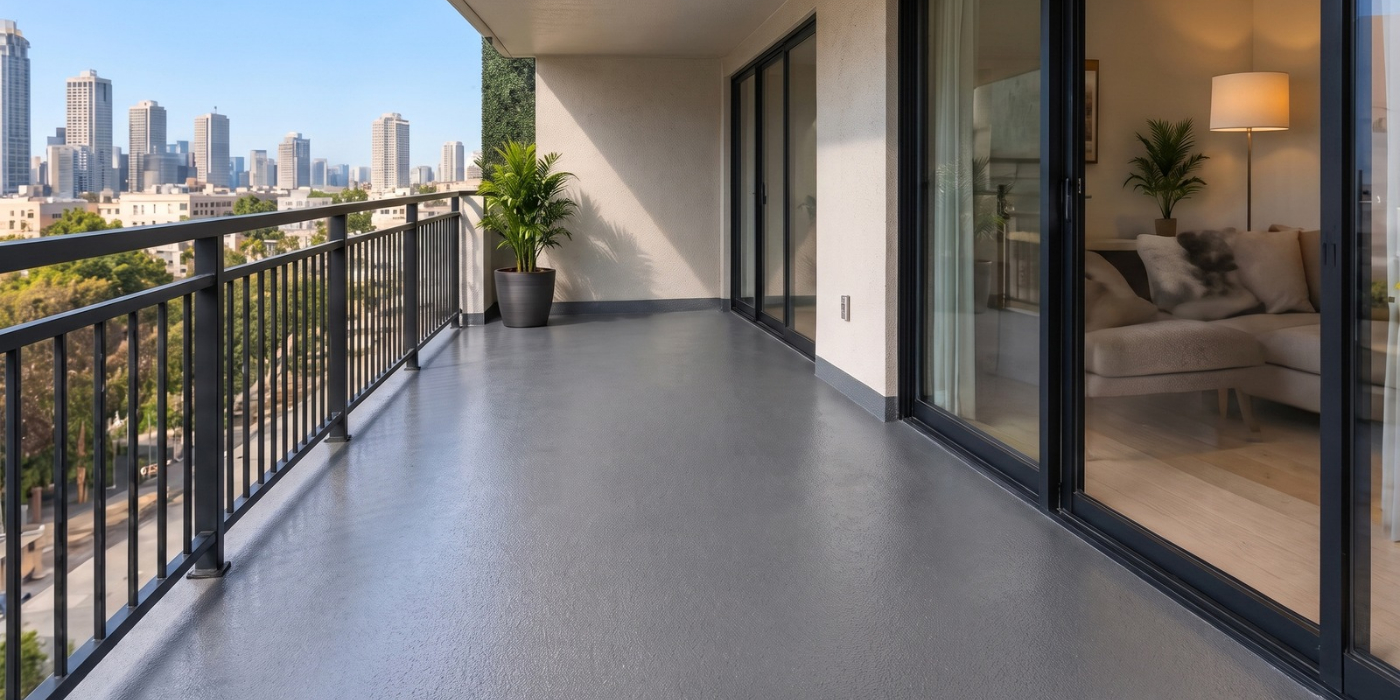
Balcony waterproofing in Los Angeles is what stands between a deck surface and the wood framing that holds it up. When the coating fails, water reaches joists and beams that were never meant to get wet, and the damage spreads out of sight until an inspector, or a structural failure, exposes it. For apartment owners and condominium associations, that hidden damage is now a legal issue as well as a maintenance one.
California’s balcony laws require licensed inspections of balconies, decks, walkways, and stairways on multifamily buildings, and both initial deadlines have passed. Allied Coatings installs City of LA approved commercial waterproof decking coatings on balconies, walkways, and roof decks across Los Angeles County. If your property received a failed inspection report or has decks showing their age, a free estimate starts with a look at the actual condition of each elevated element.
Why Waterproofing Sits at the Center of California’s Balcony Laws
California’s inspection laws trace back to a 2015 balcony collapse in Berkeley that killed six people, which led the state to form a working group on exterior elevated element failures. Two laws came out of that effort.
SB 721, codified in Health and Safety Code Section 17973, covers rental buildings with three or more units. SB 326, codified in Civil Code Section 5551, covers condominium associations. Both apply to exterior elevated elements more than six feet above grade that rely on wood or wood based products for structural support.
The detail most property owners miss is how directly the law names waterproofing. Section 17973 defines “associated waterproofing elements” as the flashings, membranes, coatings, and sealants that protect load bearing components from water. In other words, the coating on your balcony is part of what the inspector evaluates, not a cosmetic layer on top of it.
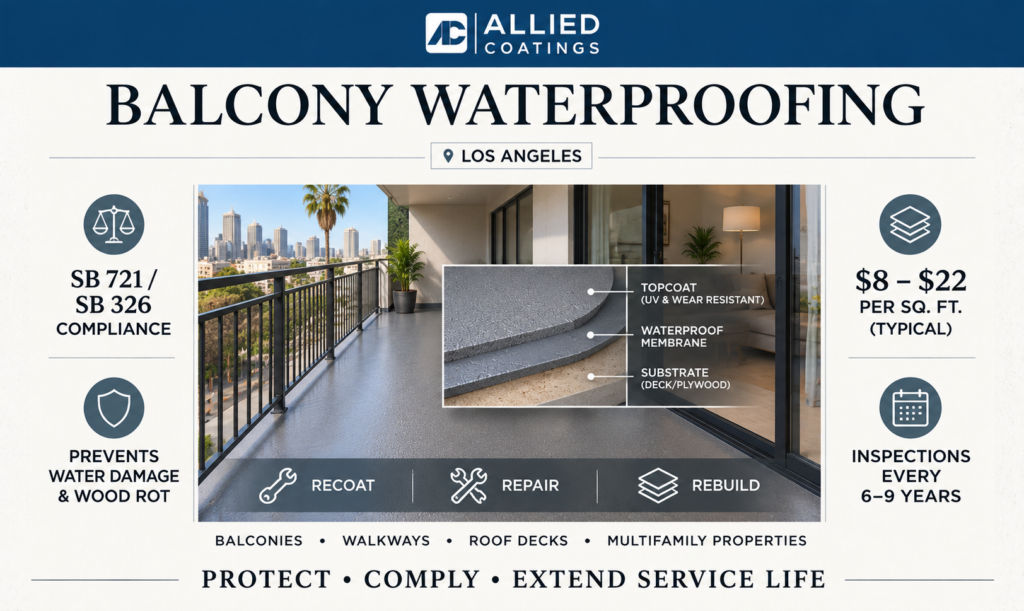
The SB 326 deadline for condominiums was January 1, 2025. Assembly Bill 2579 extended the SB 721 deadline for apartments to January 1, 2026. Reinspections follow every six years for SB 721 properties and every nine years for SB 326 associations. Under SB 721, local enforcement agencies can assess civil penalties of $100 to $500 per day when required repairs aren’t completed on time.
How Water Damages a Balcony From the Inside
Most balcony failures start where the coating meets something else: a railing post, a door threshold, a drain, or the joint where the deck ties into the building wall. Those transitions move with every temperature swing, and once the coating or sealant cracks at one of them, rainwater has a direct path to the framing below.
Wood framing that gets wet repeatedly doesn’t dry out quickly, especially on shaded, north facing units. Rot develops slowly and stays hidden under a surface that can still look acceptable from above. Los Angeles adds its own pattern of stress: wet winter storms followed by long dry, sunny stretches that break down coatings not rated for UV exposure.
That’s why a balcony with a faded or cracked surface deserves attention before the next rainy season, not after. A coating repair costs far less than replacing joists, ledgers, and posts that have been soaking for several winters.
Reading Your Inspection Report: Recoat, Repair, or Rebuild
A balcony inspection report usually sorts findings into a few categories, and each one points to a different next step.
Immediate Safety Hazards
When an inspector finds an element that poses an immediate threat to occupants, the law requires access to be restricted and the local enforcement agency to be notified. These elements need structural repair by a licensed contractor before any waterproofing goes back on.
Framing Damage That Needs Repair
Some decks show localized rot or failed flashing without an immediate collapse risk. Here, the damaged framing is replaced, and a new waterproofing system is applied over the repaired substrate and sealed at every penetration and wall transition.
Coatings at the End of Their Service Life
Many reports flag sound framing under a coating that is worn thin, cracked, or peeling. This is the least expensive finding to receive, because a properly prepared recoat restores the waterproofing before water reaches the structure.
If your report lands in the second or third category, the coating system you choose decides whether you’re fixing the problem or scheduling the same repair again in a few years.
How Much Does Balcony Waterproofing Cost in Los Angeles in 2026?
Balcony waterproofing in Los Angeles typically costs $8 to $22 per square foot for recoating or installing a new waterproofing system on a sound substrate. Projects involving wood rot, damaged framing, or structural repairs can cost considerably more.
Published estimates from Southern California contractors, including Valor Roofing and DN Builders, provide the following preliminary budgeting ranges.
| Repair scope | Estimated cost |
| Recoat an existing sound system | $8 to $15 per sq. ft. |
| New waterproofing on sound substrate | $12 to $22 per sq. ft. |
| Waterproofing with localized rot repairs | $4,000 to $8,000 per balcony |
| Full tear off and structural rebuild | $10,000 to $25,000 per balcony |
These are approximate planning ranges from different project scopes, not guaranteed quotes or Allied Coatings pricing.
Example: Waterproofing a 100 Square Foot Balcony
Consider two hypothetical repair scenarios for the same balcony.
| Scenario | Estimated cost |
| Maintenance recoat: 100 sq. ft. × $12 | $1,200 |
| Waterproofing with localized framing repairs | $6,000 |
| Additional repair expense | $4,800 |
The $1,200 recoat is appropriate only when the existing waterproofing system remains compatible and the underlying substrate is structurally sound. Applying a new coating over deteriorated wood does not correct hidden damage.
For Los Angeles apartment owners and condominium associations, early maintenance can help prevent more extensive repairs and unexpected reserve expenses. Actual costs still depend on balcony access, demolition requirements, flashing details, permits, and structural conditions.
Before budgeting for repairs, request an inspection based scope and itemized estimate. Allied Coatings offers property assessments to help identify the right waterproofing approach for each balcony.
How Allied Coatings Waterproofs Balconies and Walkways
Allied Coatings’ commercial decking systems are City of LA approved and CBO/ICC evaluated, which matters when a building department reviews repair work tied to an inspection report. The systems go on at less than a quarter inch thick, so they protect plywood and concrete decks without raising the surface enough to interfere with door thresholds or railing heights already in place.
The coatings are UV resistant and fast drying, so most decks return to use within a day or two of application instead of sitting closed for a week. That keeps tenant disruption limited on occupied buildings.
New Construction and Retrofits
On new construction, the base coat can go down during framing, before finish work covers the structural deck, giving the waterproofing full contact with the substrate from the start. On existing balconies, the old surface is removed or prepared, damaged framing found during that process is addressed, and the new system is applied and sealed at railing posts, drains, and wall transitions.
Fire and Accessibility Ratings
Allied Coatings’ commercial decking systems carry a Class A fire rating and a one hour fire rating, and they are ADA approved. Multifamily and commercial properties have fire and accessibility compliance reviewed alongside waterproofing during permitting, so the coating has to meet both.
What Lifetime Protection Looks Like in Practice
No coating protects a balcony on its own forever. Long term protection comes from pairing a rated system with a maintenance plan that follows the same inspection cycles the law already sets.
Between inspections, keep drains clear, watch for cracking at railing posts and door thresholds, and reseal transitions before they open. Allied Coatings also provides commercial caulking for the joints where decks meet walls and frames, which is where water most often finds its way in.
Properties that recoat on schedule avoid the cycle of failed reports, emergency framing repairs, and closed units, and they present a cleaner maintenance history to insurers and future buyers. Homeowners with single family decks can find similar protection through Allied Coatings’ residential waterproof decking systems.
Why Los Angeles Properties Choose Allied Coatings
Allied Coatings has waterproofed balconies, walkways, and roof decks across Los Angeles, Orange, and San Diego Counties for more than 40 combined years. Its commercial decking systems are City of LA approved, CBO/ICC evaluated, and rated for the fire and accessibility standards multifamily buildings are held to.
If your property has an open inspection finding, a coating nearing the end of its life, or a reinspection cycle coming up, Allied Coatings can assess each balcony and recommend a waterproofing scope that fits your timeline and budget. Call (800) 630-2375, email sales@alliedcoatings.com, or contact the team to schedule a site visit.
FAQs
Does balcony waterproofing satisfy SB 721 or SB 326?
Waterproofing doesn’t replace the required inspection, but it is often the repair an inspector calls for when coatings, flashings, or sealants are failing. California law treats these waterproofing elements as part of the exterior elevated element, so restoring them is part of bringing a deck back into compliance.
Who is allowed to perform a balcony inspection in California?
Only specific licensed professionals can perform these inspections, such as licensed architects and structural engineers, with SB 721 also allowing certain qualified contractors and certified building inspectors. A general handyman inspection does not count toward compliance.
How many balconies have to be inspected under SB 721?
SB 721 requires inspection of a sample of at least 15 percent of each type of exterior elevated element on the property. Inspectors can expand the scope if the sample reveals problems.
How long does balcony waterproofing take?
A single balcony or walkway can usually be coated in a day or two because the systems dry quickly. Larger properties are phased over several weeks so only a portion of units is affected at once.
Can waterproofing go on both plywood and concrete decks?
Yes. Allied Coatings’ commercial decking systems are designed for both plywood and concrete substrates, with surface preparation adjusted for each material.
How often should a balcony coating be inspected or recoated?
Most property owners align coating maintenance with the legal reinspection cycles: every six years for SB 721 apartment buildings and every nine years for SB 326 condominium associations. Decks with heavy sun exposure or foot traffic may need attention sooner.