
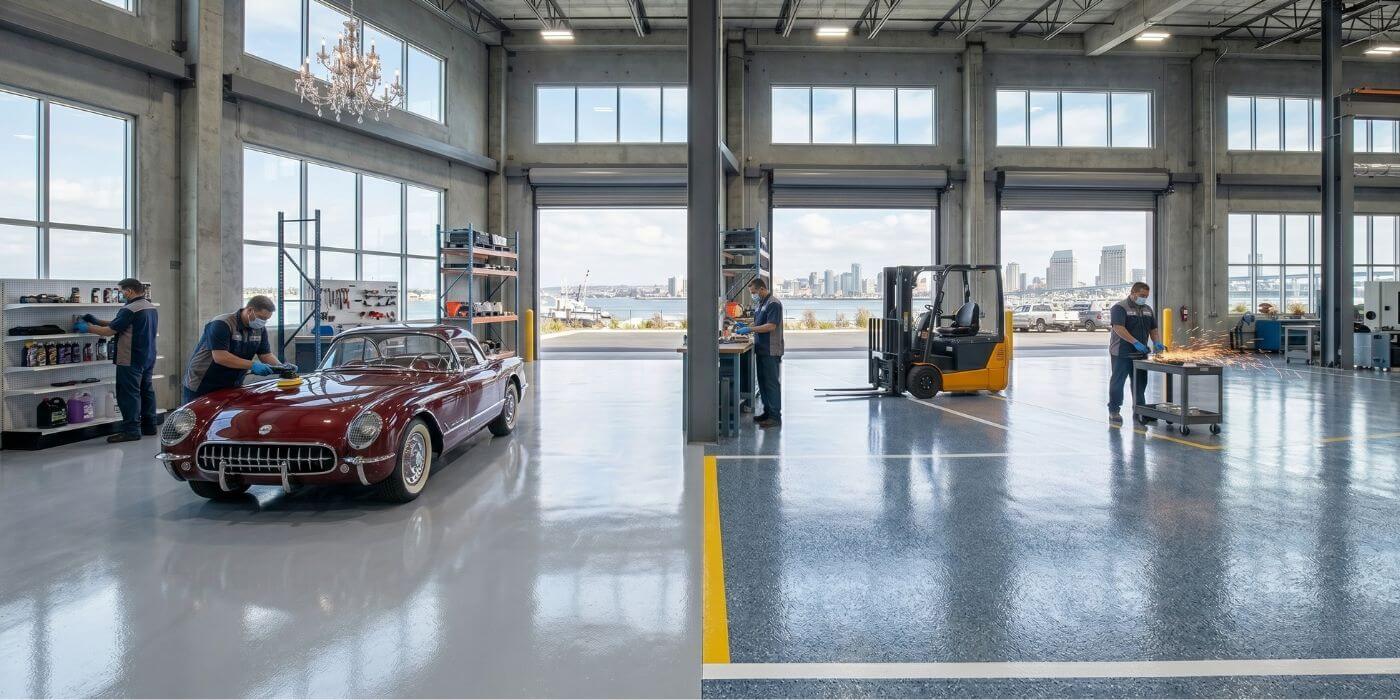
San Diego epoxy flooring for commercial and industrial facilities carries a different set of performance requirements than residential work. The county is home to more than 4,400 manufacturing establishments spanning defense, aerospace, medical devices, shipbuilding, and food production, and the floors in those facilities take punishment that a garage coating is not built to handle.
Allied Coatings has been installing commercial and industrial epoxy systems across San Diego County for over 40 years. Each floor is built on 100% solids epoxy applied over mechanically prepared concrete, using commercial-grade materials sourced through approved installer programs with manufacturers including Sika, Kemiko, Tremco, Ardex, and Tennant. Request a free estimate to get a direct assessment of your facility’s requirements.
What San Diego’s Industrial Base Demands from Flooring
San Diego’s manufacturing sector employs more than 121,000 workers across 4,400 establishments, with major concentrations in Kearny Mesa, Miramar, Otay Mesa, and Chula Vista. The floor requirements across that industrial base are not uniform. An aerospace manufacturing floor near Miramar handles different loads and exposures than a medical device production floor in the Sorrento Valley or a food processing operation in Otay Mesa.
What those environments share is the need for a coating system that bonds permanently to the substrate, tolerates chemical exposure without absorbing it, and does not become a maintenance liability within two or three years. A floor that requires patching, recoating, or full replacement on a compressed cycle disrupts operations and generates costs that dwarf the original installation savings.
Allied Coatings installs commercial epoxy systems for warehouses, manufacturing floors, airplane hangars, auto service bays, commercial kitchens, and animal hospitals across San Diego County. Each system incorporates high-performance acrylic admixtures, proprietary cement and aggregate blends, and commercial-grade sealers matched to the specific demands of the application.
Industrial Epoxy System Specifications by Facility Type
Different industrial environments in San Diego call for different system configurations. The following breakdown covers the most common facility types and what each requires from a coating system.
Defense and aerospace manufacturing facilities require floors that tolerate hydraulic fluid, aviation fuel, lubricants, and cleaning solvents without staining or degrading. Impact resistance matters in facilities where components and tooling are handled at floor level. 100% solids epoxy with a chemical-resistant urethane topcoat is the standard specification for these environments.
Medical device and biotech facilities in the Sorrento Valley and Torrey Pines corridors require seamless, non-porous floors that can be sanitized to cleanroom or near-cleanroom standards. Coved base installations that eliminate the floor-wall joint are common in these facilities. Quartz broadcast systems provide the slip resistance and chemical resistance required in wet lab environments.
Food production and commercial kitchens require floors that tolerate thermal shock from steam cleaning, resist boiling liquid spills, and maintain slip resistance under wet conditions. For facilities with heavy steam cleaning cycles, urethane cement is the appropriate specification. For commercial kitchens without sustained thermal shock exposure, a quartz broadcast epoxy system provides the chemical resistance and traction required.
Warehousing and distribution facilities across Otay Mesa and the 905 corridor require floors that handle forklift traffic, pallet jack loads, and the abrasion from constant wheeled equipment use. 100% solids solid-color epoxy in safety colors supports OSHA-compliant floor marking for traffic lanes, loading zones, and pedestrian walkways.
Auto service and vehicle maintenance facilities need floors that resist motor oil, transmission fluid, brake fluid, and gasoline without staining or softening. A chemical-resistant epoxy system with a clear or pigmented topcoat is the standard here, and the non-porous surface makes fluid cleanup straightforward.
Surface Preparation: The Variable That Determines System Longevity
The most common cause of premature epoxy failure in San Diego’s industrial facilities is inadequate surface preparation, not product failure. A 100% solids epoxy system applied to concrete that has not been mechanically opened will bond to the surface layer rather than the substrate. That surface layer, whether it carries curing compounds, contamination from years of industrial use, or the natural laitance that forms on poured slabs, will eventually release.
Diamond grinding opens the concrete’s pore structure so the epoxy can penetrate and form a mechanical bond. Existing cracks and damaged areas require repair before coating begins. A crack that is cosmetically filled without addressing the cause will reflect through the new coating within months, particularly in San Diego facilities where temperature cycling between coastal morning humidity and afternoon heat creates ongoing concrete movement.
Allied Coatings assesses substrate conditions on every project before any material goes down. The process includes evaluation of existing slab conditions, crack repair, moisture testing, and mechanical preparation appropriate to the specific system and facility type.
San Diego Site Conditions That Affect Industrial Floor Performance
San Diego’s climate presents specific installation and performance variables that affect industrial epoxy systems. Coastal facilities from Barrio Logan to Point Loma deal with elevated ambient humidity and salt air. Moisture vapor transmission through concrete slabs is higher in these areas, and a floor installed without a moisture vapor barrier on a slab that requires one will delaminate over time regardless of the product used.
Inland industrial areas including El Cajon, Santee, and Otay Mesa reach summer temperatures well above 90 degrees Fahrenheit. Epoxy applied to concrete that has been in direct sun or on a hot slab will cure unevenly, which affects both adhesion and surface appearance. Experienced installers account for these conditions in scheduling and application.
San Diego’s seismic activity also matters for industrial flooring. Older concrete slabs in established industrial areas like National City and Barrio Logan may carry existing crack patterns from prior ground movement. Those cracks need mechanical repair before coating. Coating over active cracking transfers the failure point directly to the new system.
When to Specify Epoxy vs. Polished Concrete vs. Urethane Cement
For most San Diego commercial and industrial applications, 100% solids epoxy is the correct specification. There are specific circumstances where a different system is more appropriate, and specifying the wrong one costs money without delivering the performance the facility needs.
Polished concrete is appropriate when the slab is in good structural condition and a vapor-permeable, low-maintenance surface is the priority. It does not provide the chemical resistance or seamless surface that food production, medical, or automotive facilities require.
Urethane cement is the correct specification for commercial kitchens and food processing facilities where the floor will see sustained thermal shock from steam cleaning or boiling liquid exposure. It tolerates temperature cycling that would cause standard epoxy to crack. It costs more and requires a longer installation window, but it is the right system for that exposure profile.
Epoxy remains the appropriate specification for the broad range of San Diego industrial and commercial environments where chemical resistance, impact tolerance, and long-term durability are the primary criteria.
Allied Coatings: San Diego’s Commercial and Industrial Epoxy Specialist
San Diego’s industrial base is too varied and too demanding to be served well by a contractor whose primary business is residential garage work. The surface preparation requirements, product specifications, and installation protocols for a defense manufacturing facility or a medical device production floor are different in kind, not just in scale.
Allied Coatings has been installing commercial and industrial epoxy systems across San Diego County, Orange County, and Los Angeles for over 40 years. The company works with commercial contractors managing single and multi-building portfolios, equipped to handle phased industrial projects without disrupting operations. Contact Allied Coatings to discuss your facility’s specific requirements and get a scope built around what the floor actually needs to do.
Frequently Asked Questions
How long does industrial epoxy flooring last in San Diego?
A properly installed 100% solids epoxy system over mechanically prepared concrete typically lasts 10 to 20 years in commercial and industrial environments, depending on traffic volume, chemical exposure, and maintenance practices. Coastal San Diego facilities with high moisture vapor transmission that were not treated with a vapor barrier at installation will see premature delamination regardless of the product used.
What industries in San Diego most commonly use industrial epoxy flooring?
Defense and aerospace manufacturing, medical device production, food processing, warehousing and distribution, auto service, and commercial kitchens are the most frequent applications across San Diego County. Each has distinct chemical, mechanical, and sanitation requirements that determine the appropriate epoxy system type and topcoat specification.
Does San Diego’s humidity affect industrial epoxy floor installations?
Yes. Moisture vapor transmission through concrete is elevated in coastal San Diego areas from Chula Vista to Point Loma. Contractors should conduct moisture testing before installation and apply a vapor barrier where slab readings exceed product thresholds. Skipping this step is one of the most common causes of coating failure in San Diego coastal industrial facilities.
Can epoxy flooring be installed in a facility that needs to stay operational?
Most commercial and industrial epoxy installations complete in one to three days. Allied Coatings works with facility managers to schedule installation during off-hours, weekends, or phased sections to minimize operational disruption. Foot traffic is typically possible within 24 hours and vehicle or equipment traffic within 72 hours of installation.
What is the difference between commercial epoxy and industrial epoxy flooring?
The distinction is primarily in product specification and build thickness rather than a separate product category. Industrial applications typically call for heavier build coats, chemical-resistant topcoats, and in some cases specialized additives for slip resistance, electrostatic discharge control, or thermal shock tolerance. We specify systems based on the operating conditions of the facility rather than applying a one-size specification across different environments.