
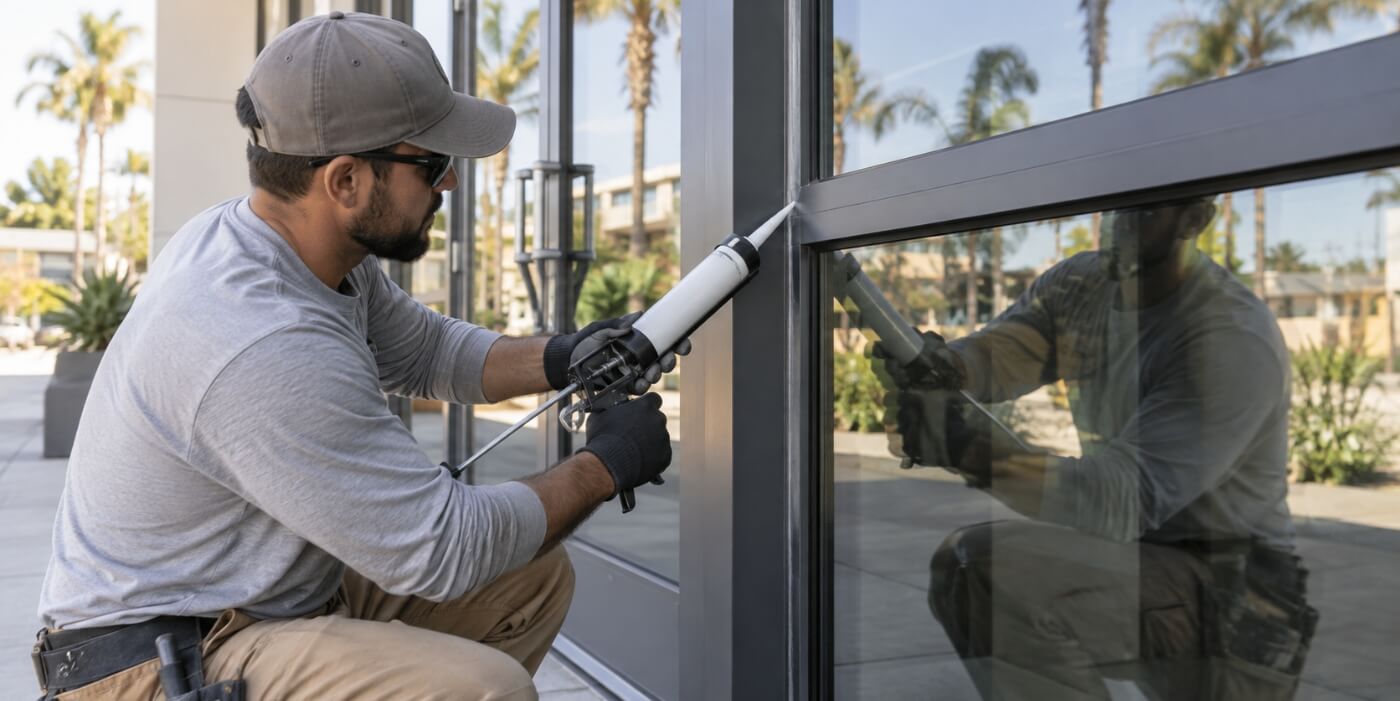
Commercial caulking contractors in San Diego spend most of their time fixing a problem that started as something nobody noticed: a quarter-inch gap around a window frame, a hairline separation where a storefront window meets its metal frame, a joint on a pool deck that opened up after a few seasons of expansion and contraction. Left alone, that small gap turns into a water stain on the ceiling below, a spike in the HVAC bill, or a call from a tenant asking why there are ants in the break room.
Allied Coatings has provided commercial caulking for San Diego County properties for more than 40 combined years, sealing joints on concrete, metal, wood, and glass across apartment complexes, retail storefronts, hotel pool decks, and office buildings. A single afternoon spent resealing the exterior envelope of a building is usually enough to close the gaps that would otherwise cost thousands of dollars in water damage, energy waste, and pest control calls over the following year.
What Commercial Caulking Prevents
Every building expands and contracts as temperatures shift through the day, and the joints between materials, concrete to metal, glass to frame, one wall panel to the next, are built to absorb that movement. Caulking and sealant systems are what do that absorbing. When they fail, the building doesn’t stop moving; it just starts letting water, air, and pests through the gaps that open up.
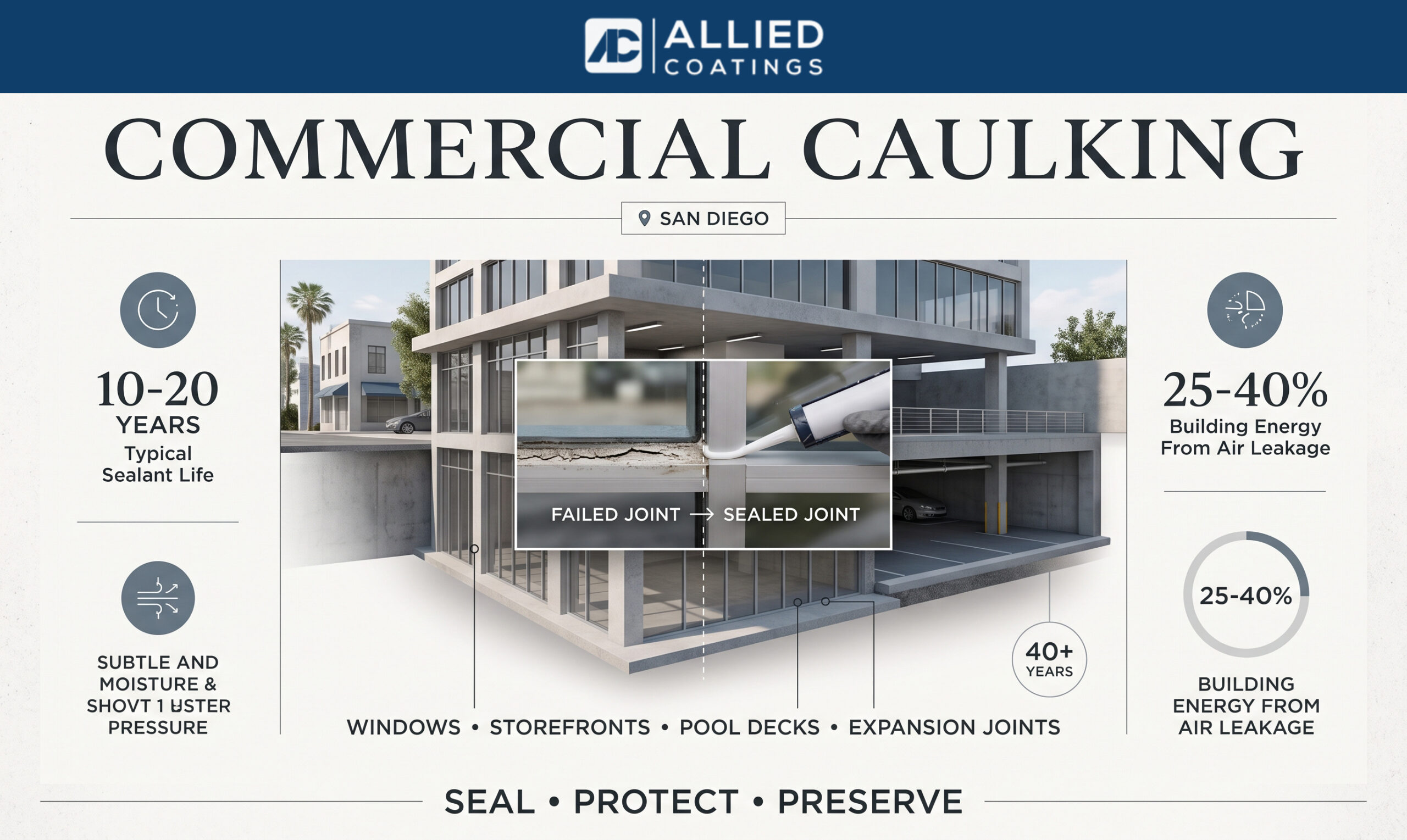
The U.S. Department of Energy estimates that air leakage accounts for between 25 and 40 percent of the energy used to heat and cool a typical building, and much of that leakage happens at exactly the joints commercial caulking is designed to seal. For a property owner paying the utility bill on a multi-tenant building, that is not a minor line item.
Beyond energy costs, failed caulking is a direct path for:
- Water intrusion through window frames, expansion joints, and rooflines, which leads to interior water damage and, eventually, mold.
- Air infiltration and drafts that make HVAC systems work harder and shorten their service life.
- Insect entry through gaps as small as an eighth of an inch, particularly around ground-floor storefronts and loading docks.
- Structural wear, since water that gets behind a facade or into a joint accelerates corrosion in metal fasteners and deterioration in concrete.
Where San Diego Commercial Properties Need It Most
Not every building has the same exposure, and the caulking that holds up on an office tower is not necessarily right for a hotel pool deck.
Retail Storefronts
Glass storefront systems rely almost entirely on their perimeter sealant to stay watertight, since the glass and metal framing themselves don’t flex the way a wall assembly does. A gap here shows up fast, usually as a puddle just inside the entrance after the first real rain.
Apartment Complexes and Multi-Tenant Buildings
Multiple units sharing exterior walls means a single failed joint can affect more than one tenant, and water intrusion complaints tend to escalate quickly into liability concerns for the property manager.
Hotel Pool Decks
Constant water exposure, pool chemicals, and sun make pool deck joints some of the hardest-working sealant applications on a property. These need materials rated specifically for chemical and UV exposure, not general-purpose caulk.
Office Buildings
Curtain wall systems and window bands depend on continuous, unbroken sealant lines. A single missed section during a previous repaint or repair job is often the source of a leak that shows up two floors away from where the water first entered.
How Allied Coatings Approaches Commercial Caulking
Every project starts with an inspection of the existing joints, since matching the wrong sealant to a surface, or applying it over old, failed caulk without removing it, is the most common reason resealing jobs fail early. Allied Coatings removes deteriorated sealant, cleans and preps the joint, and applies commercial-grade sealants matched to the specific substrate and exposure, whether that’s concrete, metal, wood, or glass, including non-toxic formulations where indoor air quality is a concern.
Because gaps this small are easy to underestimate, a full building envelope assessment is usually the better first step for property managers, rather than spot-repairing whatever leak happened to get reported this month. If your building hasn’t had its exterior joints inspected recently, Allied Coatings can walk the property and flag problem areas before they turn into service calls.
What Drives the Cost of Commercial Caulking in San Diego
Pricing for a caulking project depends on a handful of factors that vary from one property to the next. The total linear footage of joints being resealed is the starting point, but the substrate matters just as much, since removing old sealant from a curtain wall system takes longer than prepping a straightforward concrete expansion joint.
Access also plays a role. Ground-floor storefront joints are quick to reach, while upper-floor window bands on an office tower or a hotel pool deck surrounded by furniture and landscaping need scaffolding, lifts, or extra scheduling around occupied space. Properties that bundle their full building envelope into a single project typically pay less per linear foot than those calling a contractor back for one small repair at a time, since mobilization and setup costs are spread across more work.
For property managers trying to budget accurately, the most useful step is having a contractor walk the site and quote against what they see in person rather than estimating from a floor plan alone. Allied Coatings’ estimates are based on an in-person assessment of the specific joints, substrates, and access conditions on your property.
Choosing a Commercial Caulking Contractor
Caulking looks simple, which is exactly why it’s easy to get wrong. A contractor without commercial experience may use a residential-grade sealant on a joint exposed to constant sun and chemical treatment, or fail to remove old sealant properly before applying new material, both of which shorten the life of the repair to a year or two instead of a decade.
Look for a contractor who can name the specific products they’re using for each substrate, who inspects before quoting rather than pricing blind, and who has documented experience on buildings similar to yours. Allied Coatings has served thousands of commercial customers across San Diego, Orange, and Los Angeles Counties, and every quote reflects an actual site assessment rather than a generic per-linear-foot estimate.
If your property is due for an exterior joint inspection, or you’re already seeing water stains, drafts, or higher-than-expected energy bills, Allied Coatings offers free commercial caulking estimates throughout San Diego County. Contact us today to schedule a property walkthrough.
FAQs
How often does commercial caulking need to be replaced?
Most commercial-grade sealants last between 10 and 20 years depending on the material, exposure, and sun and chemical exposure the joint sees. Pool decks and south-facing storefronts tend to need resealing sooner than shaded interior courtyards.
What’s the difference between residential and commercial caulking?
Commercial sealants are formulated for larger movement ranges, heavier UV and chemical exposure, and the specific substrates found on commercial buildings, such as curtain wall glazing and structural metal panels. Residential caulk is typically rated for smaller, lower-exposure joints and fails faster when used on commercial applications.
Can caulking lower my building’s energy bill?
Yes. Since air leakage accounts for roughly 25 to 40 percent of a typical building’s heating and cooling energy use, sealing the gaps where that air escapes, mainly around windows, doors, and wall penetrations, can produce a measurable reduction in HVAC costs.
Do you caulk around existing failed sealant, or does it need to be removed first?
Old, failed sealant needs to come out before new material goes in. Applying new caulk over deteriorated sealant prevents proper adhesion and typically causes the new joint to fail within a year or two.
How long does a commercial caulking project take?
A single storefront or window band can usually be resealed in a day. Larger scopes, like a full building envelope on an apartment complex or office tower, are scheduled over several days to avoid disrupting tenants and are typically staged section by section.
Is commercial caulking disruptive to tenants or business operations?
Most caulking work is exterior and generates minimal noise or interior disruption. Allied Coatings schedules larger commercial projects to work around business hours and tenant access needs whenever possible.