
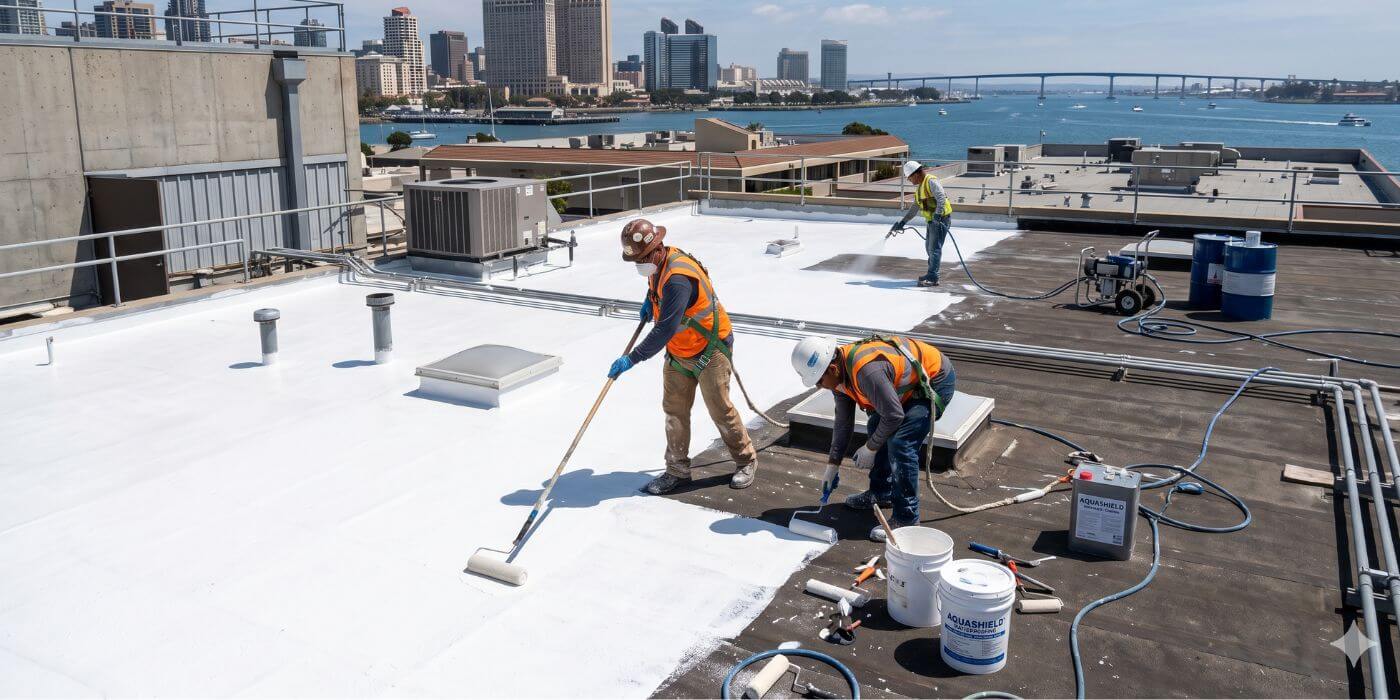
Waterproofing San Diego commercial properties is not a maintenance line item to defer until something fails. Water intrusion into decks, foundations, parking structures, and roof assemblies compounds over time. By the time visible damage appears, the structural work underneath has usually been deteriorating for months or years.
Allied Coatings has been installing commercial waterproofing systems across San Diego County for over 40 years. The scope covers above-grade deck and balcony coating, below-grade waterproofing for foundations and parking structures, and coating systems for walkways and common areas. Request a free estimate to get a direct assessment of what your property requires.
Why Commercial Waterproofing in San Diego Is Not Optional
San Diego’s climate creates specific moisture conditions that commercial buildings cannot ignore. Coastal areas carry salt air and elevated humidity year-round. Salt-laden moisture accelerates the corrosion of embedded rebar in concrete decks and balconies. Once rebar begins corroding, it expands and fractures the concrete from the inside, a process called spalling that is expensive to remediate and can compromise structural load capacity.
Inland areas including El Cajon, Santee, and Escondido face a different challenge. Seasonal temperature swings cause concrete to expand and contract, widening existing cracks and opening new ones. Each cycle creates more entry points for water. Without a waterproofing membrane across the surface, water penetrates, and in below-grade areas, the surrounding soil holds it against foundation walls under hydrostatic pressure until it finds a path through.
San Diego also sits in a seismically active region. Ground movement creates micro-cracking in slabs and foundation walls that is often invisible to a visual inspection but functionally significant for water intrusion. Waterproofing systems that accommodate substrate movement, rather than rigid coatings that crack with it, are the appropriate specification for this region.
Above-Grade Waterproofing: Decks, Balconies, and Walkways
Commercial deck and balcony waterproofing in San Diego involves more than applying a coating to a surface. The system must perform across the full range of conditions the assembly will face, including UV exposure, thermal cycling, foot and vehicle traffic, and standing water during rain events.
Allied Coatings installs above-grade waterproof deck coating systems for commercial property owners, property managers, HOAs, and contractors across San Diego County. The coating systems are CBO/ICC evaluated, Class A fire rated, and City of Los Angeles approved. Systems are less than one quarter of an inch thick, UV resistant, fast drying, and available in an extensive range of colors and finishes including knockdown texture.
The installation process starts with an on-site evaluation of the existing surface condition. After cleaning and substrate preparation, a multi-layer coating system is installed using commercial-grade materials. For contractors managing HOAs or multi-unit residential properties, Allied Coatings can coordinate phased installation across multiple buildings to keep common areas operational during the project.
A completed Allied Coatings project in La Jolla covered approximately 862 square feet of residential deck, finished in knockdown texture and sealed in Hickory. Projects of that scale and larger are routine across San Diego County commercial applications.
Below-Grade Waterproofing: Foundations, Parking Structures, and Slabs
Any portion of a commercial building that sits below ground level is in constant contact with moisture in the surrounding soil. Without a properly specified waterproofing system, that moisture works through concrete pores and joints over time, carrying dissolved salts and minerals that degrade the concrete and corrode embedded steel.
Allied Coatings installs below-grade waterproofing systems for foundation walls, slabs-on-grade, elevator pits, sump areas, and parking garages across San Diego and Southern California. The approach covers new construction and retrofits on existing structures. For new construction, Allied Coatings coordinates installation at the appropriate project phase, with base coat systems installed during the framing stage where applicable.
Per IBC Section 1805.3.2, concrete and masonry walls that retain earth and enclose interior spaces below grade are required to be waterproofed and designed to withstand hydrostatic pressure. Compliance with this requirement is not discretionary on commercial projects, and documentation of the installed system is typically required for inspections.
Allied Coatings provides complete project documentation for commercial waterproofing installations, which supports the inspection and permitting process for contractors and property owners managing multiple buildings or phased construction schedules.
Coating System Highlights and Specifications
Allied Coatings’ above-grade waterproof deck systems carry the following specifications relevant to commercial and multi-family applications:
- CBO/ICC evaluated
- 1-hour fire rated
- Class A fire rated
- Less than one quarter of an inch thick
- Low maintenance
- ADA approved
- City of Los Angeles approved
- UV resistant
- Fast drying
- Extensive finish options
For below-grade applications, system selection is based on site conditions including soil type, water table depth, hydrostatic pressure exposure, and whether the application is positive-side, negative-side, or blindside. Allied Coatings assesses these conditions on-site before specifying a system, which matters on San Diego projects where coastal soil conditions and proximity to the water table vary significantly by neighborhood.
When to Specify Waterproofing vs. Resurfacing vs. Sealer
These three interventions are often confused, and specifying the wrong one costs money without solving the problem.
A sealer is a surface treatment that reduces water absorption into concrete but does not create a waterproof membrane. It is appropriate for concrete in good condition that needs routine protection, not for surfaces already showing water intrusion, cracking, or spalling.
Resurfacing restores the surface profile and appearance of deteriorated concrete but does not address water intrusion if no waterproofing membrane is included in the system. On San Diego commercial properties with aging plywood or concrete decks, resurfacing without waterproofing leaves the substrate vulnerable.
A waterproofing system creates a continuous membrane across the surface that redirects water rather than slowing its absorption. It is the correct specification for decks, balconies, walkways, and below-grade areas where water intrusion is occurring or likely given the exposure conditions.
The Right Waterproofing System Starts with the Right Assessment
San Diego commercial properties face a specific combination of coastal moisture, UV exposure, seismic micro-cracking, and seasonal temperature swings that generic waterproofing specifications do not account for. The wrong system, or the right system applied to a surface that was not properly prepared, fails on its own schedule regardless of what was paid for it.
Allied Coatings has been assessing and installing commercial waterproofing systems across San Diego County for over 40 years. Every project starts with an on-site evaluation of the actual conditions before any system is specified. Contact Allied Coatings to schedule that assessment and get a scope built around what your property actually needs.
Frequently Asked Questions
How long does commercial waterproofing last in San Diego?
Allied Coatings’ waterproofing systems typically last 10 to 15 years or longer with proper installation and maintenance, depending on traffic volume, UV exposure, and site conditions. Coastal San Diego properties with salt air exposure and high UV loads are the most demanding environment for coating longevity.
Does commercial waterproofing require a permit in San Diego?
It depends on the scope. Per the San Diego Development Services Department, permits are generally required when work involves changes to the waterproofing system of a roof or deck assembly. Allied Coatings provides complete project documentation to support the permitting and inspection process.
Can waterproofing be installed over an existing coating?
In most cases, the existing coating should be evaluated for adhesion and condition before a new system is applied over it. Installing over a failing or contaminated surface transfers the failure to the new system. Allied Coatings conducts on-site evaluations before scope development to determine whether preparation, removal, or resurfacing is required first.
What is the difference between above-grade and below-grade waterproofing?
Above-grade waterproofing covers decks, balconies, walkways, and roof assemblies exposed to weather and UV. Below-grade waterproofing addresses foundation walls, slabs, parking structures, and other below-ground areas exposed to soil moisture and hydrostatic pressure. The two categories involve different system types, installation methods, and performance requirements.
How does San Diego’s seismic activity affect commercial waterproofing?
Ground movement in seismically active areas creates micro-cracking in concrete slabs and foundation walls over time. Rigid coating systems that do not accommodate substrate movement will crack along the same lines. Allied Coatings specifies systems appropriate to the movement exposure of the specific substrate, which is a relevant consideration across most San Diego commercial properties built on older concrete slabs.