
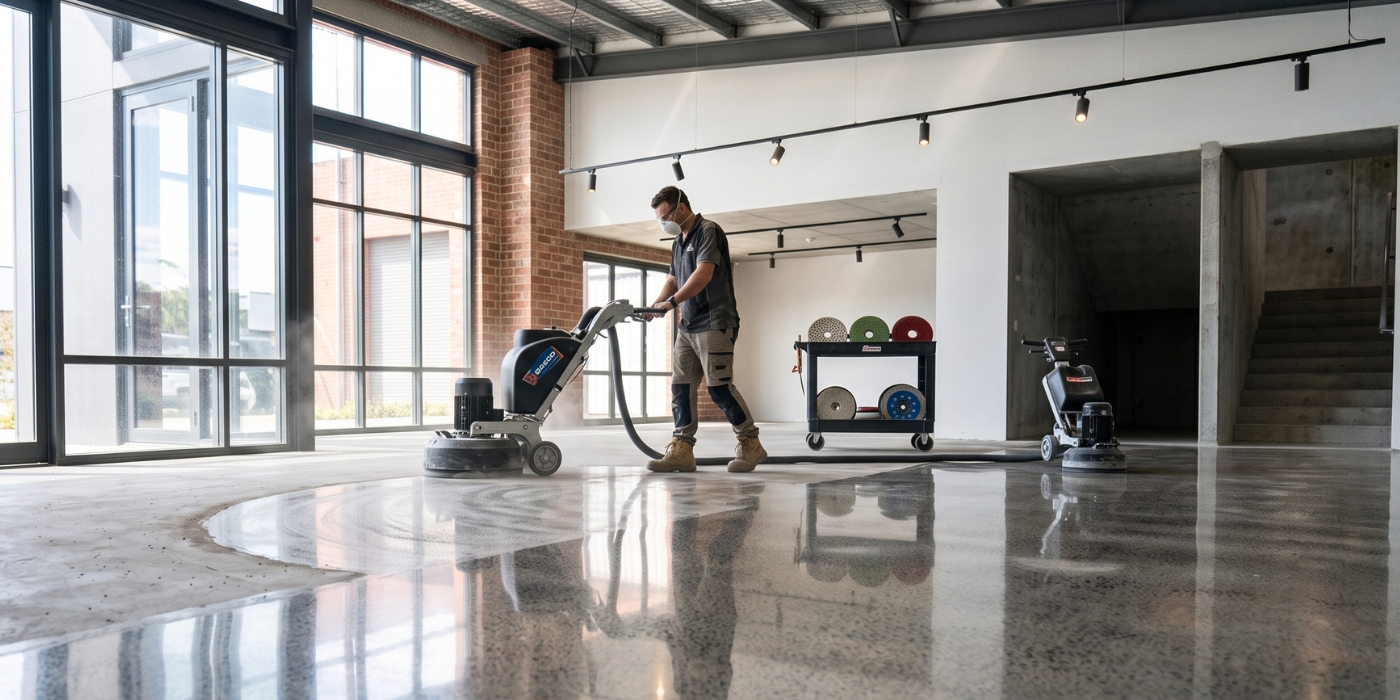
Concrete polishing in Orange County turns a plain gray slab into a light-reflecting marvel without laying anything on top. The shine comes from the concrete itself, ground smooth with diamond abrasives and chemically hardened until it starts to glow. Your floor will reflect the overhead lights and shrug off the traffic that would wear a coating through. Because there is no separate layer, there is nothing to peel, chip, or delaminate down the road.
Allied Coatings has ground, densified, and polished concrete across Southern California for more than 25 years, from commercial slabs in Orange County warehouses to home garages and interior rooms. Polishing rewards a careful read of the slab before the first pass, and every floor we take on starts with a look at what the concrete underneath can actually do.
What Concrete Polishing Actually Is
Polishing is a mechanical process done in various stages. The slab gets honed with diamond abrasives that get progressively finer, starting with coarse metal-bonded segments that flatten the surface and moving up through fine resin pads that build the shine. Partway through, a liquid densifier soaks into the concrete and hardens it from the inside. Each grit erases the scratch pattern, until the surface is smooth enough to reflect light instead of scattering it.
How the Densifier Makes It Hard and Glossy
The densifier is what separates polished concrete from concrete that has only been ground. A lithium silicate hardener reacts with the free lime in the slab and forms calcium silicate hydrate, the same compound that gives cured concrete its strength, packed into the pores near the surface. That reaction keeps working for weeks after it goes down, tightening the surface so it resists dusting, takes a higher gloss, and wears like stone. A ground floor with no densifier hazes over and chalks the moment it dries.
Choosing Your Gloss Level and Finish
The final grit sets the gloss. Stopping around 800 leaves a soft satin sheen, 1500 gives a semi-gloss, and carrying it to 3000 produces the high-gloss, near-mirror finish that shows off a showroom or a lobby. Color goes in with dyes or concrete stains before the final polishing steps lock it in.
Commercial and Residential Polishing Across Orange County
Commercial concrete polishing fits the busy floors of Orange County businesses, such as retail store floors, restaurant dining rooms, auto showrooms, and warehouse slabs that forklifts cross all day. A polished floor throws the overhead light back into the room, which cuts the lighting a big space needs, and it cleans easily with a dust mop instead of a strip-and-wax cycle.
In homes, polishing turns a garage slab or an interior floor into a surface that resists tire marks, spills, and the grit tracked in from the driveway. A great room or a garage holds its shine for years on nothing more than routine sweeping and a pH-neutral mop. The slab that was poured with the house becomes the finished floor, with no tile, plank, or coating added on top.
Is Polished Concrete Right for Your Floor?
Polishing should only be done on a slab worth polishing. Sound concrete in decent shape takes a polish beautifully, while a floor that is spalled, badly cracked, or covered in old adhesive may need repair or an overlay first. A slab with heavy moisture rising through it can also cloud a polish, which is why we test for it before quoting the job.
When the concrete underneath will not take a polish, a bonded overlay is usually the better route. Concrete resurfacing lays a fresh cementitious surface that can then be polished or finished, and epoxy flooring is the stronger choice for a shop floor that sees constant oil and solvent. Our estimators call it on the slab in front of them rather than defaulting to polishing on every job.
Why Orange County Property Owners Call Allied Coatings
Allied Coatings has polished, resurfaced, and coated concrete across Los Angeles, Orange County, San Diego, and the rest of Southern California for more than 25 years. We grind, densify, and finish with systems from manufacturers like Ardex and Sika, and we read each slab before going to work. From a single garage to a warehouse running tens of thousands of square feet, every job starts with the same look at what the concrete can do.
A polished floor starts with the slab you already have. Whether it is a garage, a retail floor, or a warehouse that could reflect its own lighting back into the room, Allied Coatings can assess the concrete and put together a free estimate for the gloss and finish you want. Contact us today to get started.
Frequently Asked Questions
What is the difference between polished concrete and an epoxy floor?
Polished concrete is the existing slab ground and hardened into a finished floor, while an epoxy floor is a resin coating applied on top of the concrete. Because polishing has no separate layer, there is nothing to peel or delaminate, and the floor is refreshed by re-polishing rather than recoating. Epoxy is the better pick where a floor needs one color throughout or heavy chemical resistance, such as a shop or lab.
How long does polished concrete last?
Polished concrete lasts for decades because the finish is the slab itself, hardened by a densifier that keeps reacting for weeks after it goes down. High-traffic commercial floors may need a re-polish to bring back full gloss over time, but the floor underneath does not wear out the way a coating does. Routine dust mopping and a pH-neutral cleaner keep it looking new.
How glossy can a polished floor be?
Gloss is set by how far the polishing is carried, from a low satin sheen around 800 grit up to a high-gloss, near-mirror finish at 3000 grit. A higher gloss reflects more light, which brightens a showroom or lobby and trims the lighting a large space needs. The gloss level is chosen up front and matched to how the floor will be used.
Does polished concrete stain or need sealing?
A densified, polished floor is far less porous than bare concrete, so it resists everyday spills without a separate sealer. It is stain-resistant rather than stain-proof, so a kitchen, auto bay, or other spill-prone space is worth finishing with a penetrating stain guard. Wiping up spills promptly keeps oil and acidic liquids from etching the surface.
How long does concrete polishing take?
Most polishing projects run a few days, since the floor moves through ten to fifteen grinding and polishing steps with densifier cure time in between. Square footage, the starting condition of the slab, and the gloss level all affect the timeline. Larger commercial floors take longer and get scoped during the site visit.