

City of Industry is not a place where flooring is an afterthought. Warehouses, manufacturing plants, automotive facilities, and commercial operations run on surfaces that need to perform under real pressure, heavy machinery, chemical spills, constant foot traffic, and the kind of daily wear that would destroy a standard floor coating in months.
What most facility managers do not realize is that the concrete already beneath their feet can be transformed into a durable, professional, and visually compelling surface without replacing a single slab. Professional concrete staining near you delivers exactly that, industrial-grade performance with a finish that reflects the quality of the business above it.
Allied Coatings has been serving commercial and industrial properties across Southern California for over 25 years, bringing technical expertise and premium materials to facilities that cannot afford shortcuts.
Ready to upgrade your facility floor? Contact Allied Coatings for a free estimate. Call (800) 630-2375 or email sa***@************gs.com.
What Is Professional Concrete Staining?
Concrete staining is a decorative finishing process that infuses color directly into the surface of the concrete rather than coating it from the outside. The stain penetrates the slab and bonds at a chemical or molecular level, creating permanent color that cannot chip, peel, or wear away the way paint or surface coatings eventually do.
For industrial and commercial facilities, that permanence is not just an aesthetic advantage. It is a practical one. A stained floor does not require the ongoing reapplication cycles that surface coatings demand, which translates directly into reduced maintenance costs and less operational disruption over time.
Types of Concrete Stains for Industrial Applications
Acid-based stains react chemically with the calcium compounds in the concrete to produce organic, variegated color effects with rich earth tones and natural depth. The results are unique to each slab, making them well suited for industrial-style spaces where character and visual texture are valued alongside durability.
Water-based stains use inorganic pigments suspended in polymer-bonded water solutions to deliver consistent, predictable color across a broader palette. They produce lower VOC emissions during application, making them the preferred choice for food and beverage facilities, commercial kitchens, and any environment where indoor air quality is a compliance consideration.
Integral color, embedded during the original concrete production process, offers superior UV stability and is particularly effective for outdoor applications including loading areas, exterior walkways, and covered commercial spaces.
Why City of Industry Facilities Choose Concrete Staining
Durability Under Industrial Demands
The manufacturing, warehousing, and commercial sectors concentrated in the City of Industry require flooring that holds up under conditions most surfaces were never designed for. Stained and properly sealed concrete resists oil, gasoline, transmission fluids, industrial cleaning agents, bleach, and chemical exposure that would degrade standard coatings quickly.
Because the color penetrates the concrete rather than sitting on top, the finish maintains its integrity even when the surface is subjected to forklift traffic, heavy equipment loads, and repeated washdowns.
Cost-Effective Upgrade Without Replacement
Replacing a commercial or industrial concrete slab is expensive, disruptive, and time-consuming. Professional staining enhances the surface you already have, delivering a premium custom appearance without demolition costs or the extended downtime that comes with a full pour.
For facility managers overseeing multiple properties, the cost differential between staining and replacement is significant, and the results are comparable in terms of longevity and performance when the work is done correctly.
Low Maintenance and Operational Efficiency
A properly sealed stained concrete floor requires routine sweeping and mopping with a pH-neutral cleaner to maintain its appearance. There is no waxing, no stripping, and no periodic recoating cycle that pulls staff away from core operations. For high-activity commercial environments where maintenance downtime has a direct cost, that simplicity carries real operational value.
Sustainable Flooring Choice
Staining works with existing concrete rather than replacing it, which eliminates the waste associated with demolition, disposal, and new material production. For City of Industry businesses that track environmental impact as part of their operations, choosing staining over replacement reduces both the carbon footprint and the material waste of a flooring upgrade.
Industrial and Commercial Applications in City of Industry
Manufacturing Facilities
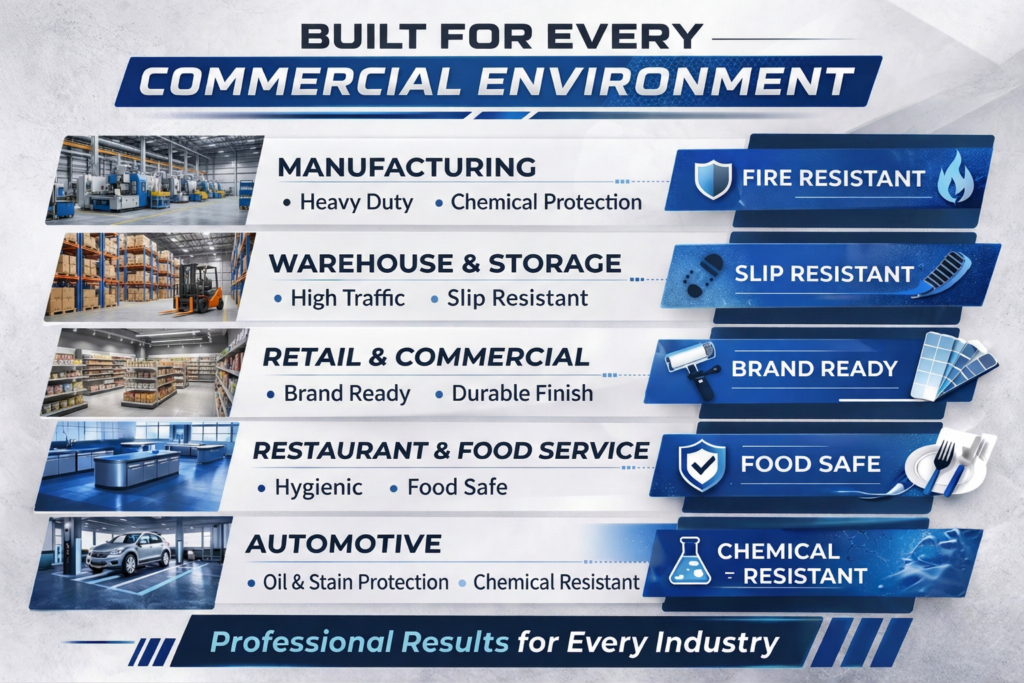
Factory floors benefit from stained concrete’s combination of durability, chemical resistance, and fire-resistant properties. Staining also allows manufacturers to incorporate branded colors and design elements directly into the floor, transforming a plain gray surface into a professional environment that reflects the quality of the operation running above it.
Warehouse and Storage Facilities
High-traffic warehouse operations demand surfaces that can take a beating without deteriorating. Heavy-duty staining systems create slip-resistant, durable floors that handle forklift traffic, pallet drops, and constant foot traffic while maintaining their appearance. Anti-slip additives incorporated into the sealer improve worker safety without compromising the finish.
Retail and Commercial Spaces
Retail businesses in City of Industry use decorative concrete staining to create customer-facing environments that reinforce brand identity. Custom color matching allows company colors to be incorporated directly into the flooring, and finishes ranging from polished to textured provide the right aesthetic for any retail concept. The durability of stained concrete means the investment holds up through years of customer traffic without needing refinishing.
Restaurant and Food Service Establishments
Water-based staining systems are specifically well suited to food preparation and service environments. Low VOC emissions during application support indoor air quality compliance, and the sealed finish is easy to sanitize and resistant to moisture, grease, and the chemical exposure that commercial kitchen floors endure daily.
Automotive Facilities and Repair Shops
Chemical and oil resistance make stained concrete one of the most practical flooring choices for automotive environments. The finish maintains its appearance despite regular exposure to gasoline, transmission fluid, brake cleaner, and industrial degreasers. Allied Coatings applies topcoat systems rated for automotive environments that go beyond standard sealers to provide the level of chemical resistance these facilities require.
The Allied Coatings Staining Process
Surface Preparation
Every Allied Coatings project begins with thorough surface preparation, which is the most critical factor in determining how long a commercial staining result lasts. The floor is cleaned, degreased, and profiled using diamond grinding or shot blasting to open the concrete’s pores and ensure maximum stain penetration.
Existing coatings, sealers, and contaminants are fully removed. Cracks and damaged areas are repaired before any stain is applied. Skipping or rushing this step is the primary cause of premature staining failures in commercial environments.
Precision Application
Allied Coatings technicians apply stains using methods matched to the stain type and the facility’s specific requirements. Spray application delivers consistent coverage across large floor areas efficiently.
For projects incorporating decorative patterns, borders, or branded design elements, controlled brush and roller techniques allow for precise, detailed work. Acid stain applications are carefully sequenced and neutralized after the chemical reaction to stabilize the surface before sealing.
Sealing and Topcoat Protection
After the stain has cured, a protective sealer is applied in the finish level selected for the facility’s use conditions. For high-traffic industrial environments, epoxy or polyurethane topcoats provide an additional layer of chemical resistance, abrasion protection, and durability beyond what a standard sealer delivers.
Anti-slip additives are incorporated where worker safety in wet or high-activity areas is a priority. Most commercial staining projects are complete within one to three days, minimizing operational downtime.
Color Options and Design Customization
Professional concrete staining offers far more design flexibility than most facility managers expect. Warm earth tones including weathered taupes, dark chestnuts, Arizona tans, and terra cottas provide sophisticated neutral palettes that work well in industrial and commercial settings. For businesses with specific branding requirements, custom color matching ensures the finished floor aligns precisely with the facility’s overall design identity.
Beyond solid color, stained concrete can incorporate decorative elements including patterns, borders, zoning lines, and marbled finishes created through layered acid staining. These effects replicate the appearance of granite, marble, or natural stone at a fraction of the material cost while maintaining the chemical and physical performance properties that industrial applications demand.
Performance Properties That Matter in Industrial Settings
Stained concrete’s thermal mass properties allow the floor to absorb, store, and release heat gradually, which moderates indoor temperature fluctuations and reduces the load on HVAC systems. In large warehouse and manufacturing spaces, that effect can translate into measurable energy savings over time.
Concrete is also inherently fire-resistant, which carries real value in facilities that handle flammable materials, chemical storage, or food processing operations where safety compliance is non-negotiable.
When properly sealed with UV-resistant topcoats, stained concrete resists fading and discoloration from sun exposure, making it equally effective for covered outdoor areas, loading docks, and exterior commercial spaces that standard interior flooring systems cannot handle.
Frequently Asked Questions
How long does concrete staining take for a commercial facility?
Most commercial staining projects in City of Industry are completed within one to three days, depending on the square footage of the floor, the condition of the existing concrete, and the complexity of the stain design or topcoat system selected.
Allied Coatings works with facility managers to schedule projects around operational hours, minimizing disruption to daily business activity. Larger industrial floors or projects requiring extensive surface preparation may take slightly longer, and Allied Coatings communicates realistic timelines clearly before work begins.
Will stained concrete hide cracks or surface damage?
Staining enhances and deepens the character of the existing surface rather than concealing structural imperfections. Minor surface variations and slight texture differences in the concrete often add to the organic, natural appearance of the finished result.
However, significant cracks and damaged areas are repaired during the surface preparation phase before staining begins. For floors with extensive surface damage, a micro-topping overlay can be applied first to create a sound, uniform substrate that accepts stain evenly.
Can staining be applied to old or heavily used industrial concrete?
Yes. Professional grinding and surface preparation can prepare aged, worn, or heavily contaminated industrial floors for staining by removing surface contaminants, opening the concrete’s pores, and repairing damage. The key is thorough preparation.
Existing coatings, sealers, adhesives, and oils must be fully removed before any stain is applied, as residual contamination prevents proper penetration and leads to uneven color. Allied Coatings evaluates every floor during the initial assessment and determines the right preparation approach for the specific conditions.
Can concrete staining be combined with epoxy or other topcoat systems?
Yes, and it is a common approach in industrial environments that require both decorative appeal and maximum performance. Staining is applied first to achieve the desired color and aesthetic, then sealed with an epoxy or polyurethane topcoat that adds chemical resistance, abrasion protection, and enhanced durability appropriate for high-demand commercial settings.
The combination delivers a finish that performs like an industrial coating while retaining the visual depth and character of stained concrete.
How do I maintain stained concrete in a commercial or industrial setting?
Daily maintenance is straightforward: sweep or dust mop to remove abrasive particles and mop with a pH-neutral cleaner for deeper cleaning. Avoid acidic or solvent-based cleaners that can degrade the sealer over time.
For facilities with heavy chemical exposure, prompt cleanup of spills prevents prolonged contact with the sealer. Resealing every two to three years, or on a schedule based on traffic volume and exposure conditions, maintains the protective barrier and keeps the surface performing as intended. Allied Coatings provides a specific maintenance recommendation for every facility after project completion.
Is stained concrete suitable for outdoor commercial areas?
Yes. Water-based stains combined with UV-protective sealer systems perform well on outdoor commercial surfaces including covered loading areas, exterior walkways, patios, and open-air commercial spaces.
UV-stable topcoats prevent fading and color shift from direct sun exposure, and the sealed surface handles moisture and temperature cycling without the deterioration that affects unsealed concrete. Allied Coatings specifies the appropriate materials for outdoor applications based on the specific exposure conditions at each facility.
What makes professional installation worth it over DIY for a commercial facility?
Commercial and industrial staining projects involve surface areas, performance requirements, and compliance considerations that consumer-grade products and general contractors are not equipped to handle reliably.
Professional installers bring industrial-grade materials, specialized equipment for surface preparation, and application expertise that determines whether the finish bonds correctly and lasts. For a facility where flooring failure means operational disruption and repeat costs, the difference between professional and DIY results is not marginal. Allied Coatings backs every commercial project with warranty coverage on both materials and workmanship.
Transform Your City of Industry Facility with Allied Coatings
The floor of your facility says something about how your operation is run. Allied Coatings brings over 25 years of commercial and industrial concrete staining expertise to City of Industry and the surrounding Southern California region, delivering finishes that hold up under real industrial demands while projecting the professionalism your business deserves.
Contact Allied Coatings today to schedule your free on-site assessment. Call (800) 630-2375, visit 795 North Ave. #D, Vista, CA 92083, or reach the team at sa***@************gs.com. You can also request an estimate online at alliedcoatings.com.