
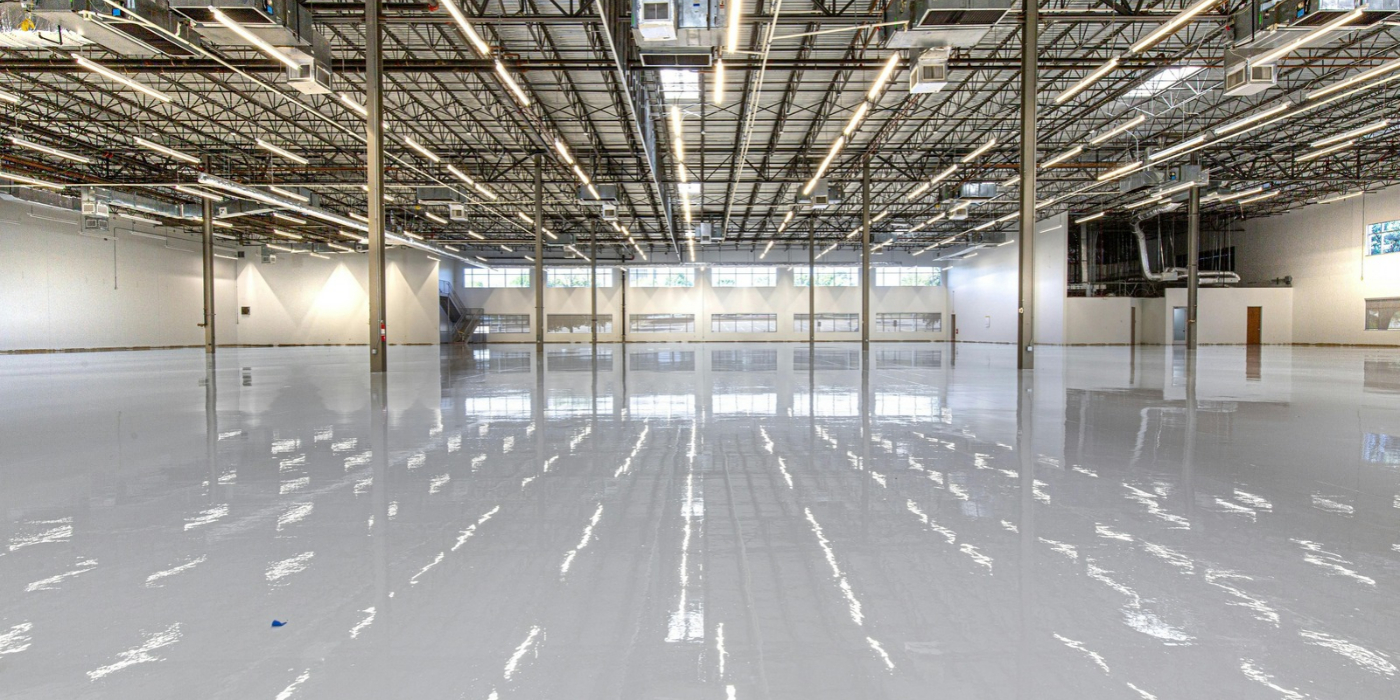
Commercial epoxy flooring in Los Angeles usually gets a second look at the worst possible moment. A coating starts peeling near the dish station, forklift tires wear through the aisle stripes again, or a lobby floor that looked sharp at move in now shows every rolling chair path. By then the floor is already costing money, and the real question is how to replace it with something that won’t fail the same way.
Most commercial floor failures trace back to a mismatch, not a bad product. A system built for an office lobby goes into a kitchen, or a thin coating goes down over a slab that was still pushing moisture. Allied Coatings installs commercial epoxy flooring across Los Angeles County by matching the system to the space first: the traffic it carries, the chemicals it sees, and how long the business can afford to close. If your current floor is already failing, a free estimate starts with a walkthrough of the actual slab, not a price per square foot quoted over the phone.
Why Commercial Floors in Los Angeles Fail Early
When an epoxy floor peels, blisters, or wears through in its first few years, the cause almost always falls into one of three categories: moisture in the slab, poor surface preparation, or a coating system that was never right for the space.
Moisture Coming Up Through the Slab
Concrete slabs poured on grade release moisture vapor continuously. If a coating seals that vapor in without accounting for it, pressure builds underneath and the coating eventually blisters or lets go. The flooring industry measures this with two standard tests: ASTM F1869, a calcium chloride test that measures vapor emission at the surface, and ASTM F2170, which uses probes set into the slab to read relative humidity inside the concrete.
Allied Coatings tests moisture before any coating goes down. When readings are high, a moisture mitigating primer or vapor barrier goes in first, so the problem is addressed at the start rather than discovered a year later.
Surface Preparation That Was Skipped or Rushed
Epoxy bonds to concrete mechanically, which means the surface has to be opened up before coating. The International Concrete Repair Institute rates this on a Concrete Surface Profile scale from CSP 1 (nearly smooth) to CSP 10 (heavily roughened), and thicker coating systems need a more aggressive profile than thin ones.
Allied Coatings prepares slabs with diamond grinding or shot blasting, removes old coatings, oil residue, and adhesive, then repairs cracks and spalled areas before primer. Budget installs that skip this step are the reason so many epoxy floors fail within a year or two.
Matching the Epoxy System to the Space
Los Angeles has an unusually wide spread of commercial property types, and each one asks something different of a floor. Choosing the right system comes down to three questions: what rolls or walks across it, what gets spilled on it, and whether it sees direct sun.
Warehouses and Light Industrial Facilities
Forklifts, pallet jacks, and dropped loads call for 100 percent solids epoxy built to absorb impact without cracking. Allied Coatings installs epoxy in safety red, yellow, blue, and green, so aisles, pedestrian walkways, and equipment zones are marked in the coating itself instead of in paint that wears off within months.
That matters beyond appearance. OSHA’s walking working surfaces standard requires workroom floors to be kept clean and, where feasible, dry. A coated floor that keeps oil on the surface instead of letting it soak into the slab makes that requirement far easier to meet.
Restaurants and Commercial Kitchens
Kitchens combine grease, nightly washdowns with industrial degreasers, and temperature swings between cooler floors and the cook line. Food grade epoxy systems are formulated for that exposure, and slip resistant aggregate such as aluminum oxide or quartz can be broadcast into the topcoat where water and grease are constant.
Medical Suites, Offices, and Retail
Treatment rooms need a non porous floor with no grout lines that stands up to disinfectants throughout the day. Lobbies, showrooms, and flagship stores need durability that still looks polished, which is where metallic epoxy and decorative flake systems come in. Both handle heavy foot traffic and rolling chairs without the wear patterns carpet shows within a few years.
Parking Structures and Sun Exposed Areas
Standard epoxy can yellow under direct UV exposure. For parking decks and other areas that see sunlight, a polyaspartic topcoat over an epoxy base adds UV stability and faster curing, while the epoxy underneath handles oil drips and vehicle traffic.
What the Installation Process Looks Like
Every project starts with an on site assessment of the slab’s condition, the space’s traffic and chemical exposure, and the business’s scheduling constraints. From there, the installation follows a consistent sequence.
Day one typically covers surface preparation: grinding or shot blasting, crack repair, cleaning, and moisture testing. Primer goes down next, followed by base coats for color and coverage. Decorative flake, metallic pigment, or slip resistant aggregate is broadcast during the base coat stage when the project calls for it, and a protective topcoat finishes the system.
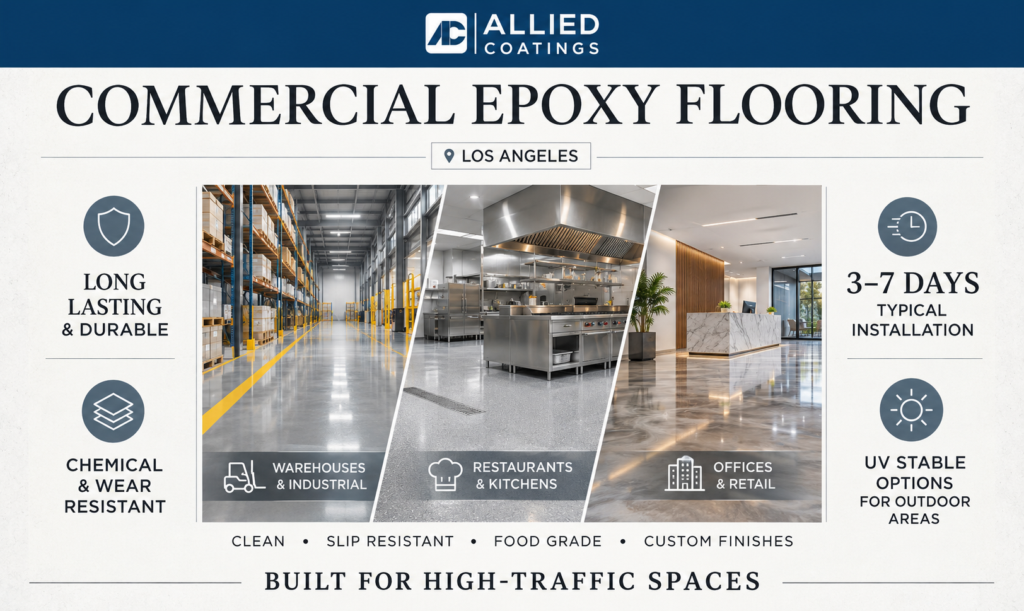
Most commercial installations take three to seven days from preparation to final topcoat, depending on square footage and the system chosen. Full cure takes about a week, though the space is usually usable before then. For restaurants, retail stores, and facilities that can’t shut down entirely, Allied Coatings phases the work in sections or schedules it during off hours.
Meeting South Coast AQMD Requirements
Any floor coating applied in the Los Angeles basin falls under the South Coast Air Quality Management District’s architectural coatings rules, which cap the volatile organic compound content of coatings and rank among the strictest such limits in the country. That’s a practical concern for occupied buildings, where tenants and employees are breathing the air during and after installation.
Allied Coatings uses low VOC and zero VOC epoxy formulations that meet these standards without giving up the chemical resistance or durability commercial floors need.
How Much Does Commercial Epoxy Flooring Cost in Los Angeles in 2026?
Commercial epoxy flooring in Los Angeles typically costs $3 to $18 per square foot installed, depending on the coating system, concrete condition, and project requirements. Published contractor estimates vary: Western Concrete lists $6 to $18 per square foot in Southern California, while Peckham Coatings estimates $3 to $14 for commercial installations and notes that Los Angeles projects tend to run 10 to 20 percent above the Western U.S. baseline.
The ranges below are for preliminary budgeting, not guaranteed Los Angeles quotes.
| Flooring system | Estimated installed cost per sq. ft. |
| Basic commercial epoxy | $3 to $6 |
| High build warehouse epoxy | $6 to $10 |
| Decorative flake or metallic epoxy | $7 to $12 |
| Specialized kitchen flooring | $10 to $18 |
Actual pricing depends on coating thickness, chemical resistance, surface preparation, and installation scheduling.
Example: A 5,000 Square Foot Warehouse
Consider a Los Angeles warehouse that needs a high build epoxy system, moisture mitigation, and concrete repairs.
| Cost component | Illustrative amount |
| Base installation: 5,000 sq. ft. × $7 | $35,000 |
| Additional moisture mitigation | $5,000 |
| Crack and joint repairs | $2,500 |
| Estimated project total | $42,500 |
This hypothetical estimate assumes the $7 base rate excludes moisture mitigation and repairs. Additional charges are illustrative, not verified contractor quotes.
That works out to $8.50 per square foot, which shows why an advertised coating price can differ from the final installed cost. Older concrete, failed coatings that have to be removed, extensive preparation, and after hours installation all push the number higher. Before approving a proposal, ask for an itemized estimate that separates preparation, materials, repairs, and curing requirements.
Over a full decade, the math favors epoxy. A commercial epoxy floor typically lasts 10 to 20 years before recoating, while painted concrete needs redoing every two to three years, and each redo means another closure. When a slab is too worn for a coating alone, commercial concrete resurfacing can restore the surface first.
For a budget built around your actual slab, Allied Coatings offers on site assessments throughout Los Angeles County.
Why Los Angeles Businesses Work With Allied Coatings
Allied Coatings has installed commercial flooring across Los Angeles, Orange, and San Diego Counties for more than 40 combined years, working with property managers, general contractors, and business owners in warehousing, hospitality, healthcare, retail, and office settings. As an approved installer for manufacturers including Sika, Kemiko, and Miracote, the company specifies formulations built for each application instead of applying one generic system to every job.
If your floor is peeling, staining, or past its useful life, or you’re planning a build out and want it done right the first time, Allied Coatings offers free estimates for commercial epoxy flooring throughout Los Angeles County. Call (800) 630-2375, email sales@alliedcoatings.com, or request a site visit to have a technician assess your space.
FAQs
How long does commercial epoxy flooring last in Los Angeles?
Most commercial epoxy floors last 10 to 20 years before recoating is needed. Restaurant kitchens and parking structures tend toward the shorter end of that range, while offices and retail spaces often exceed it. Recoating an existing epoxy floor is generally faster and less expensive than the original installation.
Can epoxy be installed on a concrete slab with moisture problems?
Yes, as long as the moisture is measured and addressed first. Industry tests such as ASTM F1869 and ASTM F2170 show how much vapor the slab is releasing, and a moisture mitigating primer or vapor barrier can be applied before the epoxy system. Skipping this step is one of the most common causes of blistering and peeling.
Can epoxy go over existing tile or vinyl flooring?
Epoxy bonds best directly to concrete, so removing existing tile or vinyl down to the slab gives the most reliable result. In some cases a coating can go over existing material after thorough cleaning, roughening, and adhesion testing. Allied Coatings evaluates each floor individually before recommending an approach.
How long will my business need to close for installation?
Most commercial installations take three to seven days, and the space is usually usable before the coating reaches full cure at about one week. Allied Coatings can phase the work in sections or schedule it during off hours so restaurants, retail stores, and warehouses keep operating in unaffected areas.
Is epoxy flooring a good choice for a commercial kitchen?
Yes. Food grade epoxy systems are non porous, hold up to nightly washdowns and industrial degreasers, and can include slip resistant aggregate in wet and greasy areas. The lack of grout lines also removes the places where bacteria and grease typically collect.
Does epoxy flooring meet Los Angeles air quality rules?
Yes, when the right formulation is used. Allied Coatings installs low VOC and zero VOC epoxy systems that meet South Coast Air Quality Management District limits for architectural coatings, which apply throughout the Los Angeles basin.