
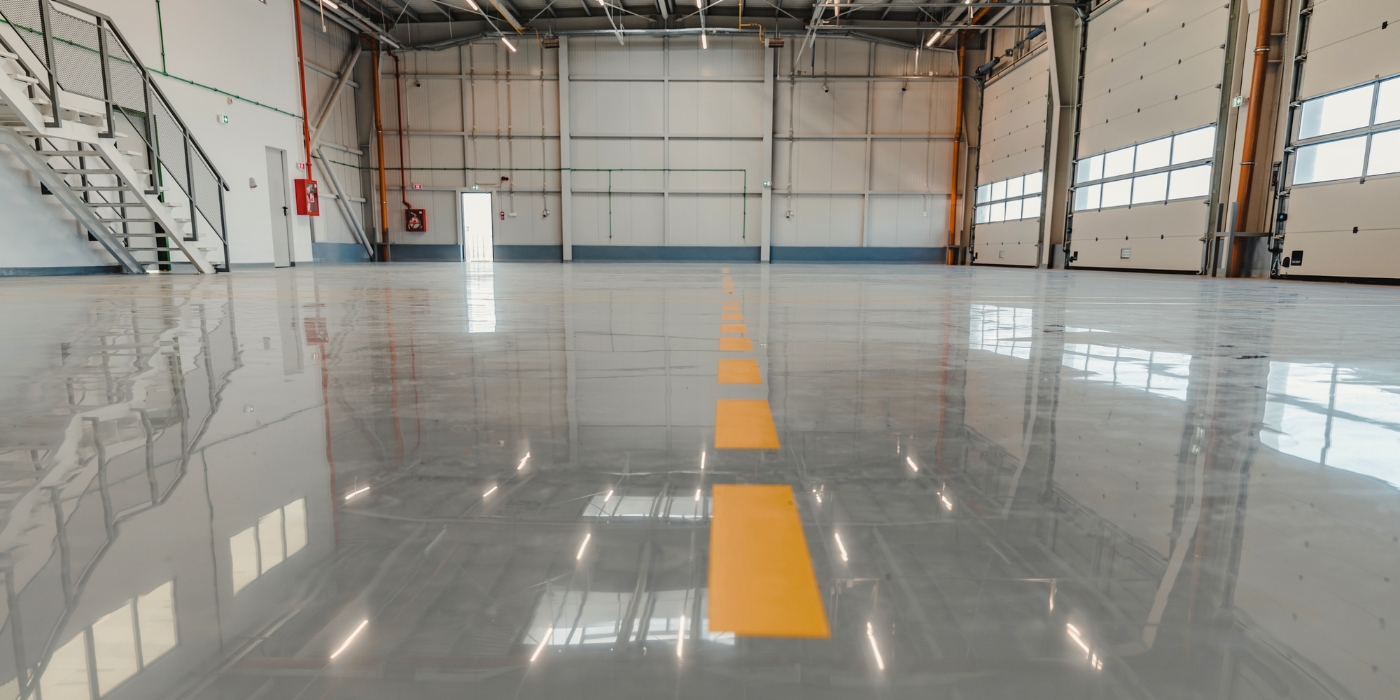
Most people looking for industrial floor coating contractors near them have a concrete floor that is failing under conditions a hardware-store epoxy was never built for. Forklifts, steel wheels, dropped tools, oil, and solvents grind an industrial slab down fast, and once it starts dusting and cracking, the whole operation slows with it.
In Orange County, the right fix almost always comes down to two materials, epoxy and polyaspartic, plus a contractor who knows when to use which.
Allied Coatings has coated industrial and commercial floors across Orange County for more than 25 years, in warehouses, manufacturing plants, and food and medical facilities. The coating is the easy part. What separates a floor that lasts from one that peels is the prep underneath it and whether the system fits how the floor gets used.
What an Industrial Floor Has to Survive
An industrial floor takes punishment a normal commercial slab never sees. Loaded forklifts and pallet jacks roll the same lanes thousands of times. Steel wheels and dropped tooling hammer the surface. Oil, coolant, solvents, and wash-down chemicals hit it from above, and in food or pharma plants it gets cleaned hard and often. Bare concrete cannot take that for long, since it is porous, soaks up oil and moisture, and dusts and cracks under the constant load.
A coating turns that slab into a hard, sealed surface that takes the abuse and cleans up easily. Orange County has no shortage of floors that need it, from the warehouses and distribution centers around Anaheim and Santa Ana to the manufacturing and aerospace shops in Irvine and Brea. What those operations share is a floor working as hard as the people on it, and a failing one costs money in repairs, downtime, and safety problems.
Epoxy vs Polyaspartic
Epoxy and polyaspartic are not interchangeable, and most of the decision comes down to picking the right one or combining the two.
Epoxy is the workhorse base. It goes on thick, often 60 mils or more on an industrial floor, cures into a hard, rigid layer, and is the most cost-effective way to build real body and strength over a slab, which is what you want under heavy machinery. Its weaknesses are time and light. Epoxy can take a day or more between coats and several days to fully cure, and on its own it yellows and chalks under UV.
Polyaspartic answers both of those. It cures in hours instead of days, it stays UV-stable so it never yellows, and it is more flexible and abrasion-resistant than epoxy, so it resists the chipping and scuffing that brittle epoxy picks up.
It goes on thinner and costs more per square foot, and because it sets so fast, it takes an experienced crew to lay down cleanly. That speed is the whole point on a working floor: a polyaspartic topcoat can have you back in operation the next day, where a full epoxy build might cost you the better part of a week.
The strongest industrial systems use both. An epoxy base builds the thickness and strength, and a polyaspartic topcoat adds the abrasion resistance, the UV stability, and the fast return to service. You end up with the body of epoxy and the toughness and speed of polyaspartic in one floor.
How to Tell a Real Industrial Contractor From a Cheap One
The materials only matter if the contractor does the boring part right, and the single biggest reason coatings fail is bad surface prep. A real industrial crew profiles the slab with diamond grinding or shot blasting so the coating bonds mechanically, and strips off any old coating, oil, and curing compound first. A cheap bid that rolls product onto a swept floor is selling you a coating that peels.
Moisture is the next thing to ask about. Concrete that gives off too much water vapor lifts a coating off from below, so a serious contractor runs moisture testing before committing to a system and adds a vapor-mitigating primer when the readings call for it.
Damaged slabs get handled before any coating goes down, with crack injection for structural cracks and resurfacing for surfaces too far gone to coat as they are.
After that, it comes down to the system and the proof. An industrial floor is not a two-car garage, and a contractor who quotes the same thin kit for both is the wrong call.
Look for someone who matches the mil thickness to your traffic, recommends epoxy, polyaspartic, or both based on how you use the space, backs the work with a warranty, and can show you finished industrial floors. An approved-installer credential for the major coating manufacturers, which Allied Coatings carries, is a sign the materials went down to spec instead of improvised.
The Coating Rules in Orange County
Orange County sits inside the South Coast Air Quality Management District, which enforces the strictest coating rules in the country. Under SCAQMD Rule 1113, floor coatings are capped at 50 grams of VOC per liter and sealers at 100, against a federal limit of 600. A product that is perfectly legal in another state can be off-limits here.
For you, that matters in two ways. Low-VOC epoxy and polyaspartic systems that meet these limits are widely available, so compliance does not cost you performance. And it is one more reason to hire a contractor who works in Orange County regularly, since they already stock compliant products and will not put something on your floor that was never rated for the district.
Cost, Timeline, and Getting It Done
Industrial floor coating is priced by the square foot, and the range is wide because the inputs vary so much. The big drivers are the condition of the existing slab, how much prep and repair it needs, the system you choose, and the size of the floor.
A straight epoxy build costs less than a full epoxy-and-polyaspartic system, and a slab that needs grinding, crack repair, and moisture mitigation costs more than one in good shape. A real contractor itemizes all of it so you are not surprised later.
Downtime is the cost that never shows up on the quote but hits the hardest, since a floor out of service is production you are not running. This is where the polyaspartic premium pays for itself: the faster cure lets a section reopen in a day, and the work can be staged area by area so the whole place never goes dark at once.
If your warehouse, plant, or facility floor is breaking down, every month you run it failing costs more in patches and lost time. Allied Coatings installs heavy-duty epoxy and polyaspartic floors across Orange County, and will walk your slab, tell you what it needs, and spec a system around your operation instead of a one-size kit.
Call (800) 630-2375 or request a free estimate, and you can see finished floors in their gallery. They also serve Los Angeles County, San Diego County, and the rest of Southern California from their shop at 795 North Ave. #D, Vista, CA 92083.
Frequently Asked Questions
For an industrial floor, is epoxy or polyaspartic better?
Neither is better on its own, since they do different jobs, and the strongest industrial floors use both. Epoxy goes on thick and builds the strength that holds up under heavy machinery, while a polyaspartic topcoat adds abrasion resistance, UV stability, and a fast cure. The right mix depends on your traffic, your chemicals, and how quickly you need the floor back.
How long does an industrial floor coating last?
A professionally installed industrial floor coating commonly lasts 10 to 20 years, and a polyaspartic-topped system tends to run toward the higher end. Lifespan depends on traffic, chemical exposure, and how well the slab was prepped. When it finally wears, a recoat usually means light prep and a fresh topcoat rather than starting over from bare concrete.
How long will my facility be shut down during the install?
It depends on the system. A polyaspartic or epoxy-polyaspartic floor can often be back in service the next day, while a full epoxy build can keep an area offline for several days while it cures. Most industrial jobs can be staged in sections so the whole operation never stops at once.
How do I choose an industrial floor coating contractor near me?
Start with surface prep, since that is where most coatings fail. A good contractor grinds or shot-blasts the slab, tests it for moisture, and specs the system and thickness to the way the floor gets used rather than quoting a one-size kit. Ask to see finished industrial jobs, confirm they carry a warranty, and check that they use products rated for your area’s air-quality rules.
Can you add safety lines or markings to an industrial floor coating?
Yes. Walkways, forklift lanes, and hazard zones can be built right into the coating system, where they hold up far better than painted-on lines that wear off. This is common in warehouses and plants where the floor doubles as a safety layout. The markings go in as part of the install, so the topcoat protects them.